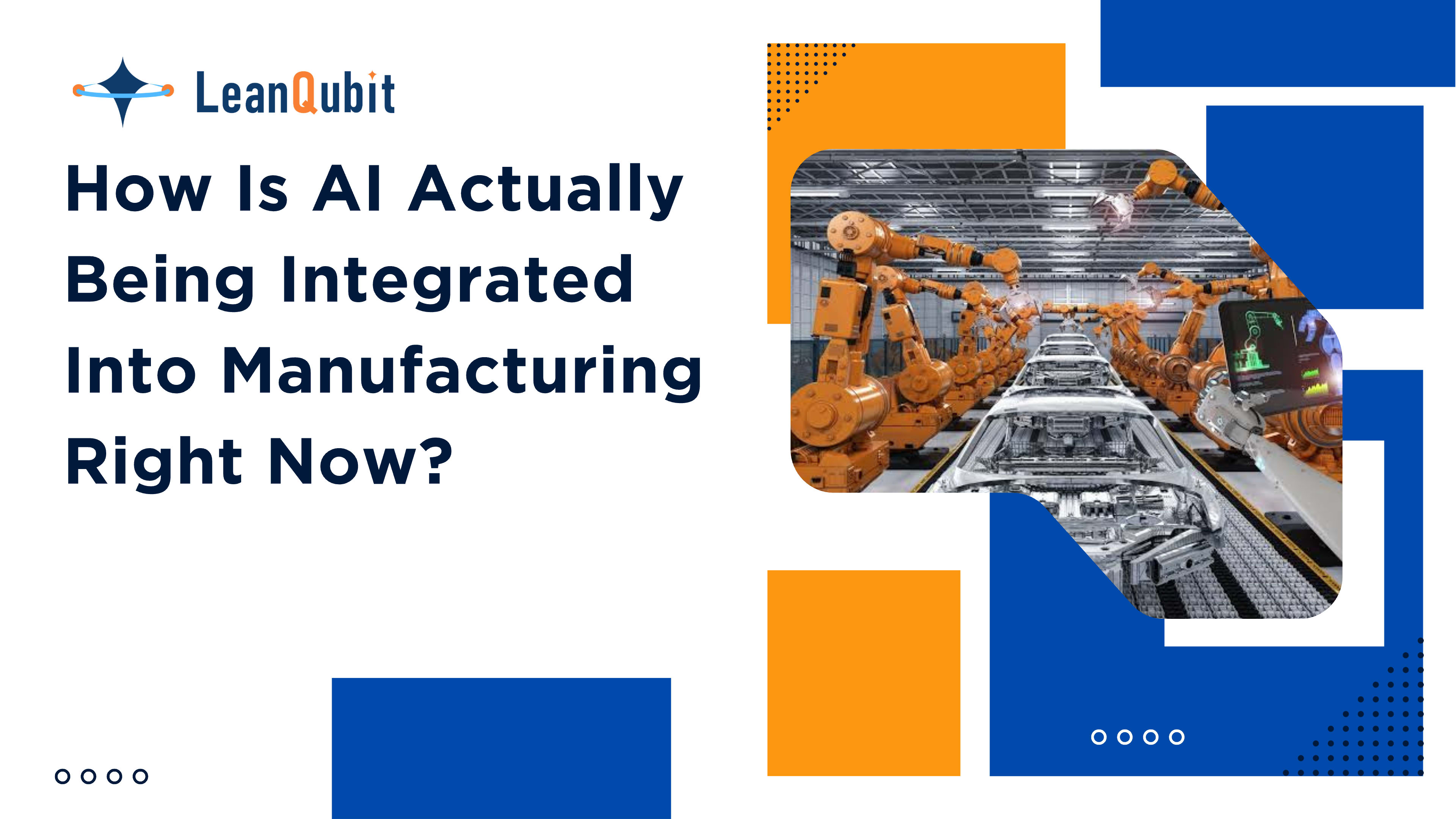
- AI is moving from passive analytics (dashboards people watch) to autonomous agents (domain-specific systems that interpret conditions and recommend action) — this is the single biggest shift in industrial software in 2026.
- The integration is not one generalist AI model. It is multiple domain-specific agents — one for maintenance, one for quality, one for production, one for procurement — each reasoning only within its own area, the same way human experts specialize.
- AI agents do not replace operators or engineers. They remove the delay between a problem forming and a person noticing it, and they hand the decision back to a human with the relevant context already attached.
- Integration follows four layers: connected plant signals, an execution and data layer (MES plus historical context), an agent reasoning layer, and an action layer that feeds maintenance, quality, and planning workflows.
- The realistic adoption path is one domain at a time — select a single operational area, validate it over four to six weeks, then expand — not a plant-wide AI rollout on day one.
What does “AI integration” actually mean on a factory floor in 2026?
Most manufacturers have already lived through one wave of AI in their plant — dashboards that use machine learning to flag anomalies, charts that highlight outliers, alerts that say something looks unusual. That wave was useful. It was also, in practice, still passive. Someone still had to be looking at the right screen at the right moment to do anything with the information.
The current shift is from AI that displays to AI that decides what matters and recommends what to do about it. Practically, this means specialized AI agents sitting on top of a factory’s existing systems — continuously interpreting plant conditions within a specific operational domain, and surfacing a recommendation in context rather than a chart that still requires a human to connect the dots.
This is not a single all-purpose AI model bolted onto a plant. It is a set of narrow, domain-specific reasoning systems working in parallel.
AI integration in manufacturing today means moving from “a dashboard that shows you data” to “an agent that watches a specific operational domain continuously and tells you what’s happening and what to do.” The agent does not act alone — it recommends, a person decides, and the workflow closes the loop.
Why isn’t one general-purpose AI model used for everything?
Because a plant doesn’t run on one kind of decision. A maintenance call is a different reasoning problem than a quality root-cause investigation, which is different again from a scheduling or material-flow decision. Each domain has its own signals, its own failure patterns, and its own definition of what “normal” looks like.
A single generalist model asked to reason about all of these at once tends to be mediocre at each one individually — it has no domain-specific grounding for any of them.
The integration approach that’s actually working in plants right now uses specialized agents per operational domain:
- A maintenance-focused agent reasons about failure risk, intervention timing, and work order prioritization — watching vibration, temperature, and runtime signals that predict mechanical issues before they cause downtime.
- A quality-focused agent reasons about defect causes, containment, and root-cause investigation — connecting process parameters to quality outcomes faster than a manual investigation would.
- A production-focused agent reasons about bottlenecks, line conditions, and throughput decisions — watching the floor in real time rather than relying on yesterday’s report.
- A materials/procurement-focused agent reasons about consumption trends and replenishment timing — coordinating material flow with what’s actually happening on the line.
Your quality lead doesn’t make scheduling calls, and your scheduler doesn’t diagnose defects — because each role requires a different kind of expertise applied to a different kind of signal. Domain-specific agents mirror this. Each one gets good at exactly one type of operational reasoning instead of being mediocre at four.
What’s the actual architecture behind this — how does data become a recommendation?
AI agent integration in manufacturing is built in four layers, each depending on the one beneath it.
Layer 1 — Connected plant signals. Machine data, process parameters, execution events, and business signals (orders, quality records) provide the live inputs. This is the raw material every agent needs — without it, there’s nothing to reason about.
Layer 2 — Data and execution context. Raw signals on their own don’t mean much without history and structure. This layer — typically an execution backbone plus a unified data layer — turns raw data into meaningful plant context: what’s normal for this machine, what this part’s traceability history looks like, what happened last time a similar pattern appeared.
Layer 3 — Agent reasoning layer. This is where the domain-specific agents actually operate — each one reasoning over its own slice of context, using the appropriate signals and history for its specific operational question.
Layer 4 — Operational action layer. Recommendations from the reasoning layer feed directly into maintenance, quality, and planning workflows — with human oversight built into the loop wherever a decision has real operational or financial weight.
An agent is only as good as the context layer beneath it. An AI model with no connection to real plant history and execution data is reasoning blind — which is why integration depends on a unified data foundation as much as it depends on the AI itself.
Will AI agents replace operators and engineers?
This is the question every plant manager is thinking and most won’t ask directly in a sales conversation — so it deserves a direct answer.
No. The integration model is built around supporting decisions, not removing the people who make them. An agent doesn’t fix the motor, approve the schedule change, or sign off on a quality hold. It surfaces the pattern — often hours or weeks before a person would have caught it through manual monitoring — and hands the decision to the person whose job it actually is, with the relevant context already attached.
An agent that removes the human from every decision isn’t actually safer or more capable — it’s just unaccountable. The integration model that’s working in practice keeps a person in the loop for anything with real operational or financial consequence. The agent’s value is in catching what would otherwise be caught too late, not in deciding alone.
What changes for the people doing the work is the timing and the starting point of their decision — not whether they’re making it. A maintenance engineer who used to discover a failing bearing during an unplanned stop now sees the same failure pattern three weeks earlier, with time to schedule the fix instead of reacting to it.
Do you need a full platform before AI agents can be useful, or can you start with one thing?
You can start with one domain. This is the practical integration path that’s actually realistic for most manufacturers, and it mirrors how every successful deployment we’ve seen begins.
Step 1 — Select the first operational domain. Start wherever the plant most needs faster decision support — usually maintenance or quality, since those tend to have the clearest, most measurable pain.
Step 2 — Validate context and workflow fit. Before scaling anything, confirm the data feeding the agent is strong enough to produce a useful recommendation, and that the workflow around it (who receives the alert, who acts on it) actually works.
Step 3 — Deploy and measure one agent path. Run the first domain in production, track the outcome against a baseline, and confirm the value loop holds with real users — not just in a demo.
Step 4 — Expand to multi-domain intelligence. Once one agent has proven its value loop, add the next domain. Cross-functional reasoning — where a scheduling agent and a maintenance agent’s recommendations inform each other — becomes possible once each individual domain is solid.
A realistic deployment for the first domain runs four to eight weeks from initial connection to a measured outcome. Expansion to additional domains happens in the months that follow, once the first agent has demonstrated real value with real users — not on a fixed calendar.
What’s the difference between this and the analytics dashboards manufacturers already have?
Most plants already have dashboards — OEE tracking, downtime logs, quality metrics, all visualized reasonably well. The gap isn’t visibility. It’s interpretation and follow-through.
A dashboard’s job ends at displaying the data. Someone still has to be watching, has to notice the pattern, has to decide it matters, and has to act — and that chain of human attention is where delay creeps in. Root-cause investigations start after a defect is already found. Maintenance becomes reactive because nobody was staring at the vibration trend at the exact moment it started drifting.
An AI agent picks up exactly where the dashboard’s job ends: watching continuously rather than waiting to be looked at, interpreting the pattern in the context of what’s normal for that specific machine or process, and surfacing a recommendation rather than just a number.
Dashboards report what already happened. Agents are built to catch what’s starting to happen — and tell someone what to do about it before it becomes a loss.
Frequently asked questions
An AI agent in manufacturing is a domain-specific software system that continuously interprets plant conditions within one operational area — such as maintenance, quality, production, or procurement — and surfaces a recommended action in context, rather than simply displaying data on a dashboard. Unlike a generalist AI model, each agent reasons only within its assigned domain, using the signals and historical context relevant to that specific type of decision.
AI agents integrate through a layered architecture: connected plant signals (machine, process, and business data) feed into a data and execution context layer (typically an MES plus a unified data platform), which feeds the agent reasoning layer, which in turn feeds an operational action layer connected to maintenance, quality, and planning workflows. This means agents sit on top of and connect to existing SCADA, ERP, and MES systems rather than requiring a full replacement of current infrastructure.
No. AI agents are designed to surface recommendations with relevant context attached, while leaving the actual decision — approving a maintenance action, signing off on a quality hold, adjusting a schedule — to a person with appropriate oversight. The value of the agent is in catching a pattern earlier than manual monitoring would, not in removing human judgment from operational decisions.
Manufacturing decisions vary significantly by domain — a maintenance decision relies on different signals and reasoning than a quality root-cause investigation or a scheduling decision. A single generalist AI model reasoning across all of these tends to perform moderately at each rather than well at any. Domain-specific agents, each focused on one type of operational reasoning, mirror how human expertise is already organized in a plant and tend to produce more relevant, actionable recommendations.
A typical first deployment — selecting one operational domain, connecting the relevant data sources, and validating the agent’s recommendations against real outcomes — takes four to eight weeks. Expansion to additional domains follows once the first agent has demonstrated measurable value with real users, rather than on a fixed timeline.
A dashboard displays data and requires a person to notice, interpret, and act on it. An AI agent continuously interprets data within its domain and surfaces a recommended action in context, closing much of the gap between when a problem starts forming and when a person becomes aware of it. Dashboards remain useful for visibility; agents address the interpretation and follow-through that dashboards were never designed to provide.
Yes. The realistic and most common adoption path starts with a single operational domain — usually maintenance or quality — validated over four to eight weeks before expanding to additional domains. A full multi-domain deployment from day one is rarely the practical starting point; value is proven incrementally, one domain at a time.
LeanQubit Inc. is a US-based industrial AI company. MaintIQ, QualIQ, ProdIQ, ProcIQ, FactoMES, FactoIQ, and FactoLake are LeanQubit products.