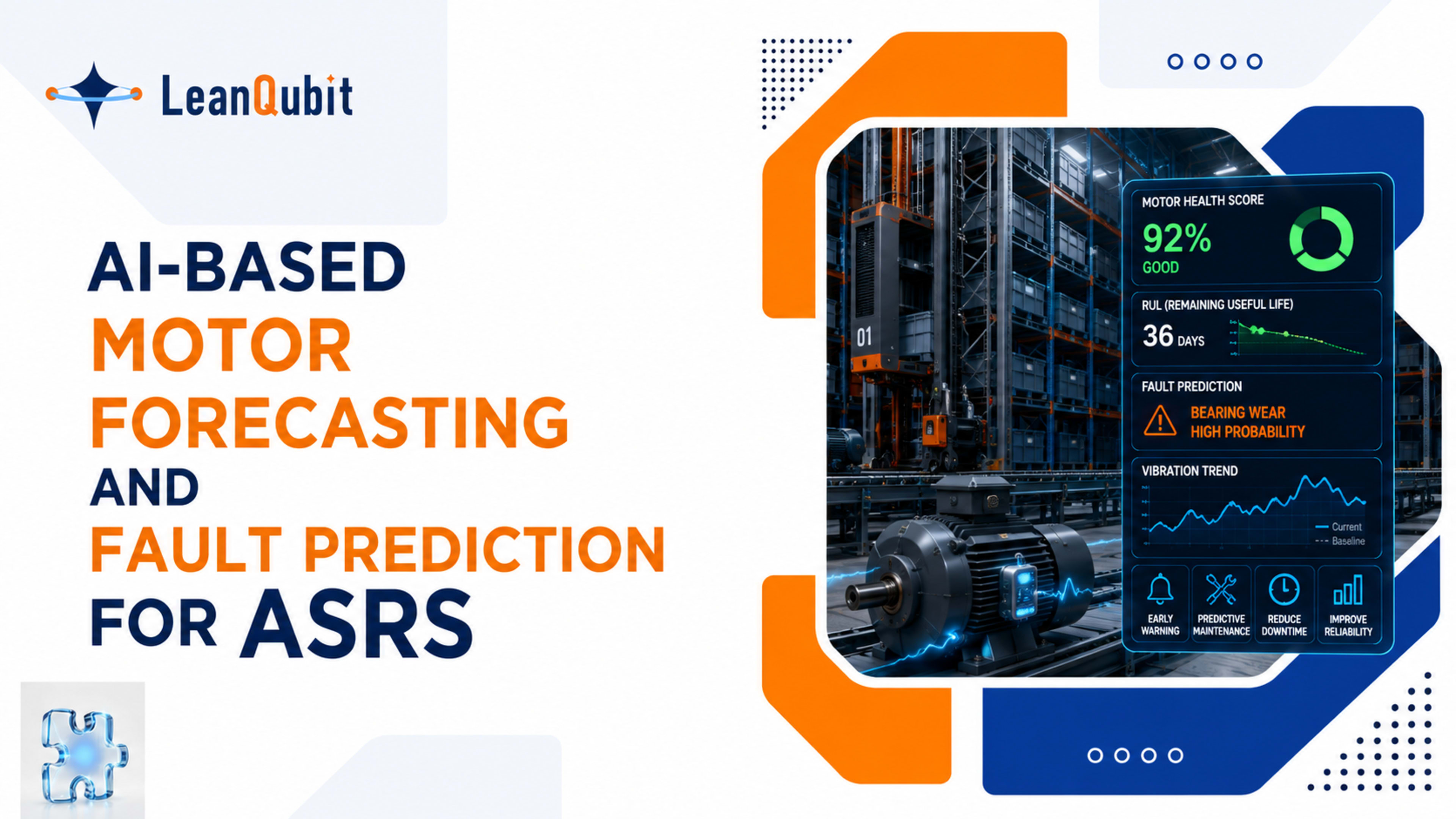
ASRS motors drive every retrieval and placement movement across the three axes of motion — when a motor problem develops, it can directly disrupt automated warehouse throughput.
The proposed solution combines motor behavior forecasting with fault-type prediction, giving early visibility into changing motor conditions before they escalate into failures.
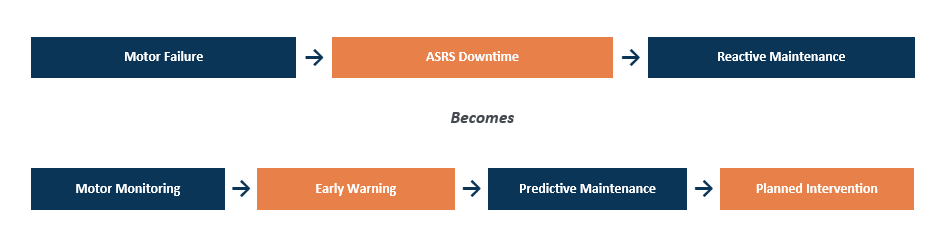
The goal is to shift motor maintenance from a reactive, failure-driven activity to a planned, condition-based activity — supporting higher ASRS availability and operational continuity.
1. Executive Summary
Automated Storage and Retrieval Systems (ASRS) are a core part of modern warehouse automation, relying on precisely coordinated motors to move, retrieve, and place boxes across a three-axis structure. Because these motors operate continuously, their condition has a direct impact on warehouse throughput, order fulfilment timelines, and overall operational reliability.
Today, most organizations only become aware of a motor problem once performance has already degraded or a failure has occurred — at which point the ASRS may already be experiencing disruption. This use case describes an AI-based Motor Forecasting and Fault Prediction solution designed to close that visibility gap.
The solution analyzes motor sensor behavior — such as current, vibration, and RPM — to understand how a motor is currently operating, forecast how its behavior is likely to change in the near term, and predict whether the motor appears healthy or faulty, including the likely fault category when a fault is indicated. This information is intended to support maintenance and operations teams in investigating and planning intervention earlier, rather than reacting after a motor issue has already affected ASRS operations.
2. Industry Context
What is an ASRS?
An Automated Storage and Retrieval System (ASRS) is a warehouse automation solution that uses robotic and mechanical equipment to move boxes and loads between storage locations without manual handling. A typical ASRS structure moves along three axes of motion to reach any storage location within the racking system, retrieve the required load, and deliver it to the designated point.
Why Motors Are Critical to ASRS Operation
Motors are the driving force behind every ASRS movement. They are responsible for:
Moving the robotic mechanism across the three axes of travel
Transporting boxes from storage to designated locations
Positioning boxes accurately for retrieval and placement
Executing repeated retrieve-and-place cycles throughout the operating shift
Sustaining continuous, high-frequency warehouse movement operations
Because ASRS motors operate almost continuously and are mechanically critical to system movement, their ongoing health is directly tied to the availability and reliability of the entire warehouse automation system.
3. Problem Statement
In most ASRS environments today, motor condition is not actively monitored for early signs of change. A motor problem typically becomes visible only when performance has already degraded significantly, or when the motor fails outright and interrupts operation.
For an ASRS, an unaddressed motor problem can potentially lead to:
Unexpected downtime of the ASRS system
Interruption of automated box movement and cycle continuity
Delays in storage and retrieval operations
Unplanned maintenance intervention
Reduced overall warehouse operational efficiency
The underlying business question this use case addresses is: How can changes in motor behavior be identified early, and how can potential motor problems be flagged before they become a major operational issue?
4. Proposed AI Solution
The proposed solution is an AI-based Motor Forecasting and Fault Prediction system. It uses motor sensor information — such as current, vibration, and RPM — to build an ongoing understanding of how each motor is operating, and to surface early indicators of change before they develop into operational problems.
The solution consists of two complementary, high-level AI capabilities:
4.1 Motor Forecasting
A time-series forecasting capability looks at a motor’s current behavior and forecasts how its sensor behavior is likely to change in the near future. In simple terms, it answers the question:
What is this motor’s behavior likely to look like shortly in the future?
This forward-looking view can help highlight potentially abnormal or gradually changing motor behavior earlier than would otherwise be noticed.
4.2 Motor Fault Prediction
A fault-prediction capability analyzes a motor’s current sensor behavior and classifies its condition as either Healthy or Faulty. When a fault is identified, the system can further indicate the likely fault category, such as:
Ball fault
Inner race fault
Outer race fault
Together, forecasting and fault prediction give maintenance and operations teams both an early warning of changing motor behavior and a clearer indication of what type of problem may be developing.
5. How It Works — High Level
The solution follows a straightforward, high-level flow from motor sensor data to a maintenance-ready recommendation:
Motor sensor signals are continuously observed while the ASRS is in operation. The AI analyzes this behavior to understand current motor condition, forecasts how the behavior is trending, and predicts whether the motor is healthy or faulty. When an early warning is raised, it is passed to maintenance and operations teams as an input for investigation and planning — not as an automatic shutdown trigger.
6. ASRS Application
In a typical ASRS deployment, a robotic shuttle or crane is continuously moving through the warehouse to retrieve and place boxes. This movement is driven by motors responsible for the three axes of motion — horizontal travel, vertical lift, and load handling / extraction. All three sets of motors operate repeatedly throughout each shift and are essential to completing every retrieval and placement cycle.
Applied to this environment, the solution:
Continuously observes the sensor behavior of the motors driving each axis of movement
Builds an understanding of each motor’s current operating condition
Forecasts how each motor’s near-term behavior is likely to trend
Identifies potentially abnormal behavior as it emerges
Predicts whether a given motor currently appears healthy or faulty
Identifies the likely fault category when a fault condition is indicated
This information can then be used by maintenance and operations teams to investigate the specific motor and plan intervention — before the issue develops into a larger operational disruption. The system is intended to support this decision-making; it does not claim to guarantee that a failure will be prevented.
7. Predictive Maintenance
The central concept behind this use case is a shift in how motor-related maintenance is approached:
Rather than waiting for a motor to fail and disrupt ASRS operation, the objective is to continuously monitor motor behavior, understand what it indicates, forecast where it is heading, and predict potential faults — so that maintenance can be planned and scheduled proactively, on the team’s terms rather than in response to an unplanned stoppage.
8. Business Benefits
At a high level, this type of motor intelligence can support the following potential benefits for ASRS operators. These are described as potential benefits of the approach, not guaranteed or measured results.
Reduced Unexpected Downtime
Earlier visibility into changing motor behavior can help reduce the likelihood of unplanned ASRS stoppages caused by motor issues.
Improved ASRS Availability
Fewer unplanned motor-related interruptions can support more consistent day-to-day availability of the automated system.
Operational Continuity
Early identification of potential motor problems supports uninterrupted storage and retrieval operations across shifts.
Operational Continuity
Early identification of potential motor problems supports uninterrupted storage and retrieval operations across shifts.
Enabling Predictive Maintenance
Forecasting and fault prediction provide the visibility needed to move from reactive, failure-driven maintenance toward planned, condition-based maintenance.
Earlier Problem Identification
Maintenance teams can be alerted to potential motor issues earlier, giving them more time to investigate and plan a response.
Improved Visibility Into Motor Health
Continuous monitoring provides ongoing insight into the condition of motors that are otherwise difficult to inspect during active operation.
Better Maintenance Planning
Advance indication of potential motor issues can help maintenance teams schedule intervention at planned times rather than during unplanned stoppages.
Support for Throughput and Reliability
By helping reduce motor-related disruptions, the solution can support more reliable and consistent warehouse throughput over time.
9. Future Vision
Motor forecasting and fault prediction represent one building block within a broader vision of intelligent, connected warehouse operations. As ASRS systems, sensors, and automation infrastructure become more integrated, this type of motor intelligence can extend into a wider industrial intelligence framework — one where equipment health insights, operational data, and maintenance planning are connected across the entire warehouse.
Over time, motor-level insights such as these can become part of a larger smart-warehouse ecosystem, supporting a more complete, real-time understanding of equipment condition alongside other operational indicators — helping organizations move progressively from isolated monitoring toward more coordinated, intelligence-driven facility operations.
10. Conclusion
ASRS motors are central to the movement, positioning, and throughput of automated warehouse operations. When motor problems go undetected until failure, the impact can extend well beyond the motor itself — disrupting retrieval and placement cycles and reducing overall warehouse efficiency.
The proposed AI-based Motor Forecasting and Fault Prediction solution offers a path toward earlier visibility into motor condition — helping teams understand current motor behavior, forecast near-term changes, and predict potential faults before they escalate. By supporting a shift from reactive to predictive, condition-based maintenance, this use case is intended to help ASRS operators work toward greater availability, operational continuity, and long-term reliability of their automated warehouse systems.