AI Capsule Defect Detection | FactoVision Computer Vision | LeanQubit.ai
SHARE
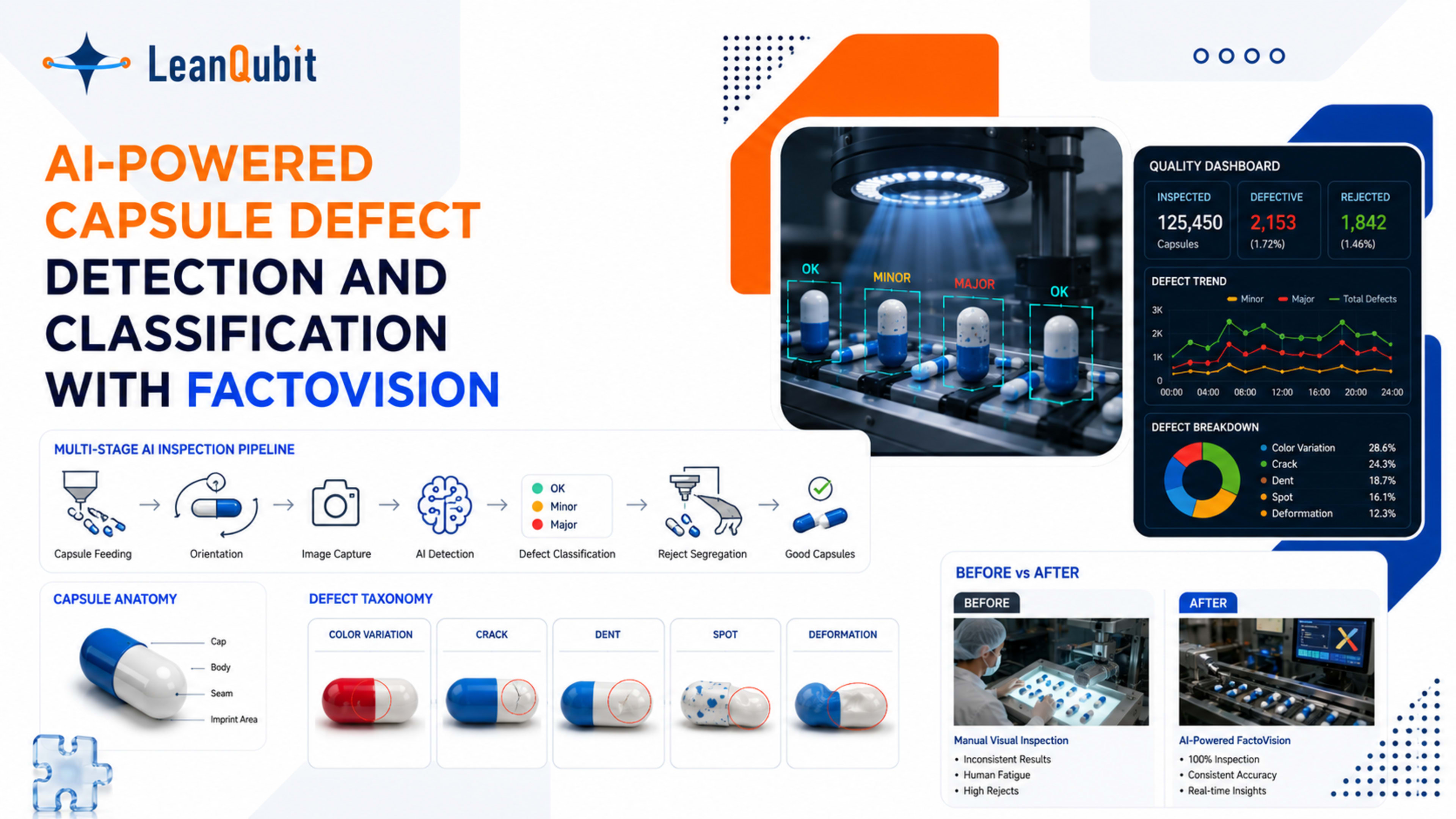
AI-Powered Capsule Defect Detection and Classification with FactoVision
From manual visual inspection to automated, edge-based pharmaceutical quality monitoring. LeanQubit transformed manual capsule inspection into a multi-stage computer vision workflow that detects defective capsules, classifies defect categories, segregates rejects, and provides live quality analytics
We replaced manual, operator-dependent capsule inspection with an automated FactoVision camera inspection workflow.
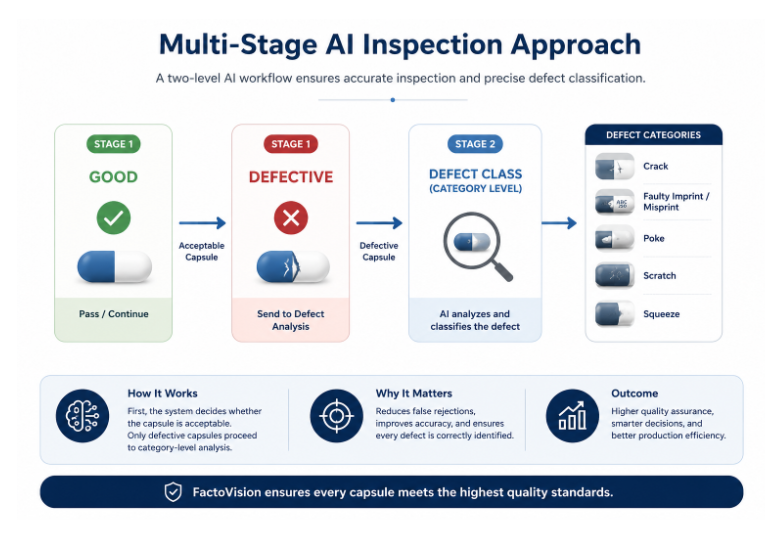
We structured the AI approach in two stages: first classify each capsule as good or defective, then classify the defect type for defective capsules.
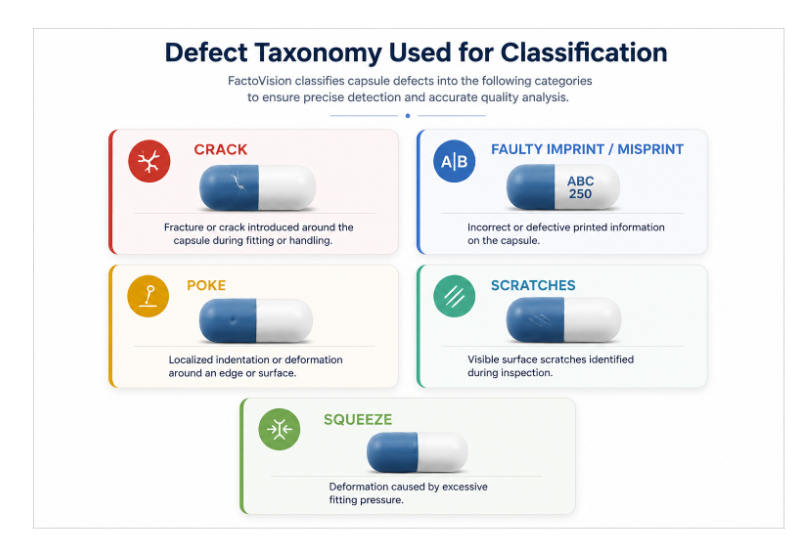
The solution identifies crack, faulty imprint or misprint, poke, scratch, and squeeze defects without exposing model-specific implementation details.
Defective capsules are mechanically segregated so only accepted product continues downstream.
The on-premises, edge-based architecture keeps the inspection and decision workflow close to the production line.
Inspection performance improved from the previously reported manual level of about 70% to approximately 96–97% with the AI-assisted approach.
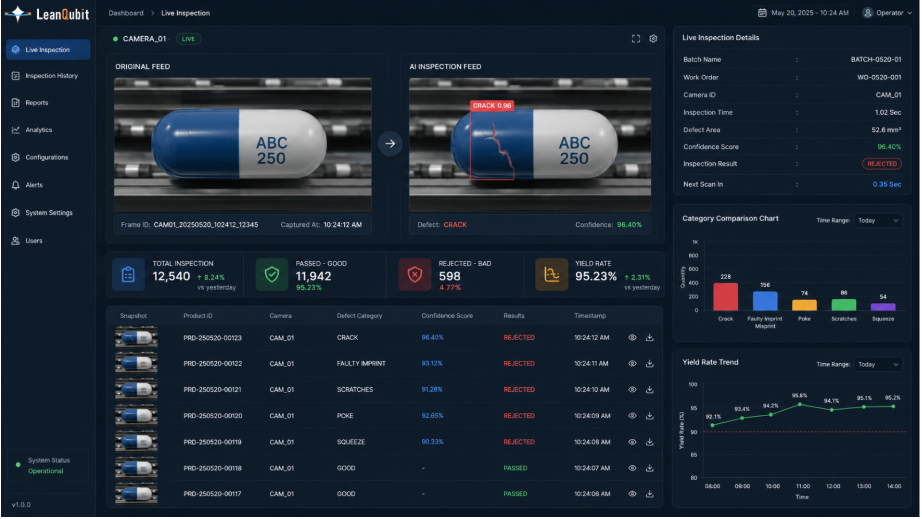
FactoVision also provides live defect-category and yield visibility through a quality dashboard, helping teams investigate recurring manufacturing issues.
At LeanQubit, we worked with an early-stage pharmaceutical capsule manufacturer that relied heavily on manual visual inspection to identify defective capsules before downstream operations. Capsules move through the production line in a controlled, single-file flow, and operators visually inspect them for defects that can arise during head-and-body fitting as well as from incorrect or faulty imprinting.
The existing inspection process was labor-intensive and dependent on continuous human attention. The client reported an inspection accuracy of approximately 70%, meaning a meaningful share of defective units could pass through the manual inspection process.
We addressed this by deploying FactoVision as an on-premises edge computer-vision solution. Cameras capture individual capsule views as they pass the inspection point, and our AI workflow makes a first-stage good-versus-defective decision. Defective capsules then move through a second classification stage that identifies the defect category. The bad units are mechanically segregated, while accepted capsules continue forward.
The resulting system delivered a practical industrial inspection workflow with approximately 96–97% inspection accuracy and a live quality dashboard that shows defect categories, trends, and yield-rate information. The project demonstrates how LeanQubit can turn a repetitive visual task into a structured, measurable, and scalable quality process.
Industry / Use Case Context
The use case sits within pharmaceutical capsule manufacturing, where product quality depends on consistent capsule formation, correct head-and-body fitting, and correct product identification or imprinting. In this environment, defects are not only a product-quality concern; recurring defect patterns can also signal machine, pressure, handling, or process conditions that should be investigated.
Context
Case Study Detail
Industry
Pharmaceutical / capsule manufacturing
Product flow
Capsules travel in a controlled single-file flow on a rail / tray-style path
Inspection point
After capsule printing and before downstream acceptance / segregation
Primary quality goal
Separate acceptable capsules from defective capsules automatically
Secondary goal
Identify which defect category is occurring so recurring issues can be investigated
Deployment model
On-premises, edge-based processing
The Business Challenge
The client had production equipment in place but had not yet reached the level of automated, technical visual inspection needed for reliable capsule quality monitoring. The inspection task was therefore performed manually, with operators watching capsules as they moved through the line and removing defective units when they were identified.
The challenge was not simply to detect a bad capsule. The client also needed to understand what kind of defect was occurring, how frequently it appeared, and whether recurring patterns pointed to a process or machine issue.
Why manual inspection became a bottleneck
Manual inspection depended on sustained operator attention and visual judgment.
Defective capsules could be visually subtle, especially when the defect occurred around the head-and-body fitting region.
The same inspection point needed to identify multiple defect families rather than a single defect condition.
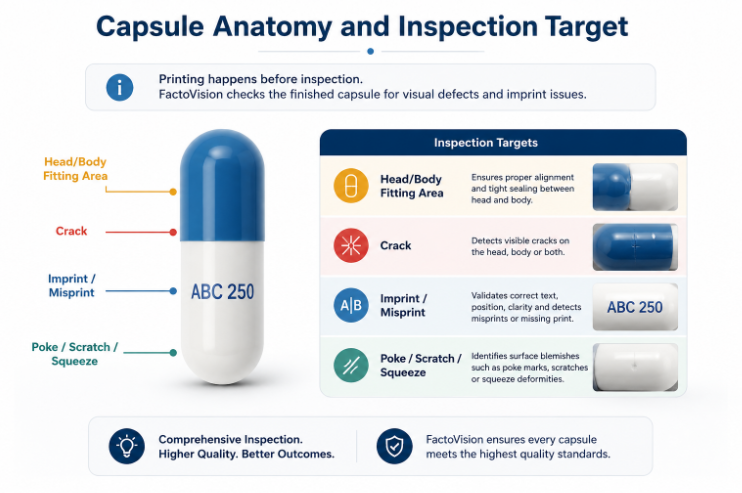
Printing had already occurred before inspection, so visual verification needed to include imprint correctness as well as physical capsule condition.
Manual inspection produced a binary quality decision but did not provide structured, live defect analytics for process investigation.
MANUAL BASELINE
The case-study input provided by the project team reports approximately 70% accuracy for the previous manual visual inspection process. This figure is used as the documented baseline for the comparison in this draft.
Existing Operational Workflow
Before our implementation, operators performed the inspection visually while capsules moved one-by-one along the production path. The work consisted of observing each capsule, determining whether it looked acceptable, and manually removing units that appeared defective.
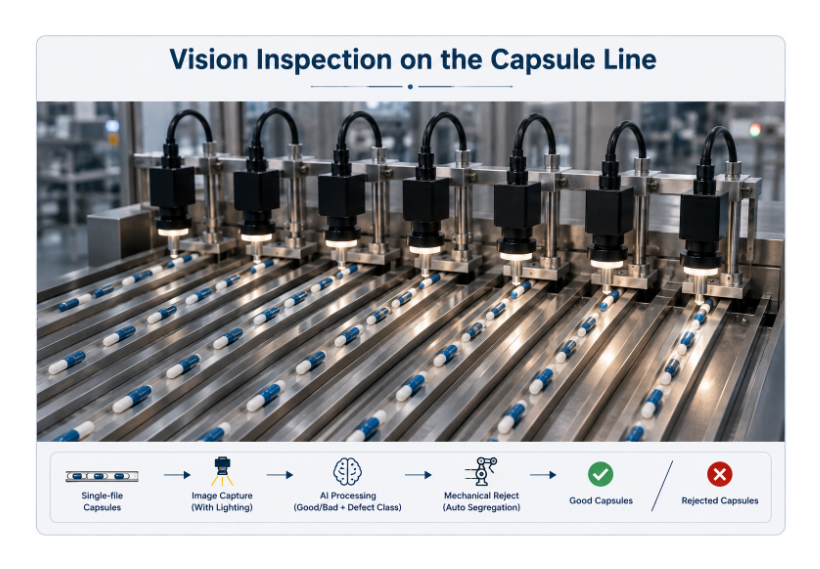
Recommended visual: high-level inspection-line concept showing camera capture, FactoVision AI, and mechanical segregation.
Documented workflow
Capsule head and body are fitted together during manufacturing.
Printing is completed before the inspection stage.
Capsules move in a single-file sequence through the inspection area.
An inspection camera captures capsule images at the inspection point.
FactoVision evaluates the image and determines whether the capsule is good or defective.
Defective capsules proceed to defect-category classification.
Accepted capsules continue downstream; defective capsules are mechanically segregated.
Why the Problem Was Difficult
The inspection problem was difficult because defects could originate from more than one mechanism and could have very different visual signatures. A simple binary detector would answer only part of the client’s need.
Recommended explanatory visualization: capsule head/body structure and the inspection target around the fitting and printed areas.
The system needed to answer two questions
Is the capsule acceptable or defective?
If it is defective, which defect category does it belong to?
That distinction shaped the overall AI architecture. Instead of forcing one classifier to solve every decision at once, we designed a multi-stage inspection workflow that mirrors the operational decision tree used by the customer.
Our Solution - FactoVision
At LeanQubit, we implemented the solution using FactoVision, our AI-driven visual inspection platform. The solution combines camera-based inspection, edge inference, structured defect classification, automated segregation, and live quality analytics.
What we implemented
Industrial camera-based visual capture at the inspection point.
On-premises edge processing so image analysis can run close to the production line.
Multi-stage AI inspection: good versus defective first, defect-category classification second.
Automatic mechanical segregation of defective capsules.
FactoVision quality dashboard for defect trends, category counts, and yield-rate visibility.
A modular architecture suitable for multiple production lines.
IMPLEMENTATION POSITIONING
We intentionally describe the solution at the system and workflow level. Specific model names, model architectures, training framework names, camera vendors, and other sensitive implementation details are excluded from this public-facing source document.
How We Designed and Developed the AI System
Our engineering approach focused on making the inspection system useful on the production line rather than building a model in isolation. We considered the capsule flow, the visual inspection point, the required pass/fail decision, the defect taxonomy, and the downstream physical segregation step as one connected workflow.
1. Define the inspection target:
We formalized the visual quality problem around the complete capsule: physical condition, fitting-related defects, and printed information.
2. Capture real production images:
We worked with the visual conditions of the operating line so the AI workflow was designed around the actual appearance of capsules in motion rather than an idealized laboratory setup.
3. Build a two-stage decision flow:
We separated acceptance classification from defect categorization so the system could first establish product status and then provide a more specific explanation for rejects.
4. Connect AI decisions to automation:
A defective decision is not useful by itself. We therefore connected the inspection decision to mechanical segregation so the bad unit is removed from the accepted product stream.
5. Expose the information operationally:
We integrated the results into a FactoVision dashboard so manufacturing teams can see defect trends and yield information in a usable form.
Recommended explanatory visualization: two-stage inspection logic from good/bad classification to defect-category analysis.
AI / Computer Vision Development Pipeline
The AI development pipeline was structured around a production-grade inspection loop: capture, analyze, classify, act, and learn from the operational signal.
Stage
What Happens
Output
Image capture
Camera observes each capsule as it passes the inspection zone.
Inspection frame
Stage 1 classification
AI evaluates whether the capsule is acceptable or defective.
GOOD / DEFECTIVE
Stage 2 classification
Only defective units are further categorized.
Defect category
Decision integration
The result is passed to the downstream handling logic.
Pass / reject decision
Mechanical segregation
Defective units are physically removed from the accepted flow.
Separated reject stream
Analytics
Inspection results are aggregated in FactoVision.
Defect trends / yield visibility
How the Algorithm Works - High-Level Explanation
We intentionally keep the algorithm description at a solution level rather than exposing proprietary model details. At runtime, the camera captures an image of the passing capsule and sends the visual information into the FactoVision edge-processing pipeline.
The first decision layer answers the most important production question: is this capsule acceptable? If the capsule passes, it continues through the process. If the capsule fails, the system invokes the second-stage defect classification logic to identify the defect family.
Decision flow
Capture capsule image.
Normalize and evaluate the visual content at the edge.
Classify the capsule as GOOD or DEFECTIVE.
For DEFECTIVE capsules, classify the defect category.
Register the result in the inspection record.
Trigger the appropriate downstream mechanical segregation action.
Aggregate the result for dashboard analytics.
Defect Categories
The classification taxonomy was designed to give the client more than a simple reject count. It gives them a structured way to understand what kind of defect is occurring and where recurring patterns may require investigation.
Recommended visual: defect taxonomy card set for crack, faulty imprint/misprint, poke, scratches, and squeeze.
Defect Category
Description / Manufacturing Context
Crack
Crack associated with capsule fitting or handling, including defects that can arise while the head and body are brought together.
Faulty Imprint / Misprint
Incorrect or defective printed information on the capsule. Printing occurs before the inspection stage.
Poke
Localized deformation or indentation that can occur around the capsule surface or edge during fitting.
Scratches
Visible surface scratching identified during visual inspection.
Squeeze
Capsule deformation that can result from excessive fitting pressure during head-and-body assembly.
Inspection, Segregation, and Production Flow
The value of the system comes from closing the loop between AI detection and physical handling. When a capsule is classified as defective, the result is used to route the unit into the reject path rather than allowing it to continue with accepted product.
Operational behavior
Good capsule: pass the inspection decision and continue downstream.
Defective capsule: classify the defect, record the event, and route the unit to mechanical segregation.
Dashboard: retain the inspection outcome for live quality monitoring and later analysis.
WHY THIS MATTERS
The system changes inspection from a visual observation task into an operational control loop: detect → classify → segregate → analyze. That structure is central to the business value of the implementation.
On-Premises Edge Deployment
We deployed the solution on premises with edge-based processing. This architecture keeps the image-analysis workflow close to the production equipment and avoids making the inspection decision dependent on a remote processing round trip.
High-level architecture
Layer
Role in the solution
Industrial cameras
Capture the passing capsule imagery at the inspection point.
Edge inference layer
Runs the FactoVision visual inspection workflow locally.
Decision / control interface
Passes the inspection outcome to the downstream handling logic.
Mechanical segregation
Removes defective capsules from the accepted product flow.
FactoVision dashboard
Presents defect categories, trends, and yield information.
FactoVision Dashboard and Quality Intelligence
We also connected the inspection outcomes to a FactoVision dashboard so the client could see not only whether production was generating defects, but which defect categories were appearing and how the quality signal was moving over time.
Recommended visual: FactoVision quality dashboard concept with inspection status, accuracy, defect-category distribution, and yield visibility.
What the dashboard enables
Live visibility into good versus defective production.
Defect-category breakdown for crack, imprint, poke, scratch, and squeeze conditions.
Defect trend monitoring to identify recurring patterns.
Yield-rate visibility for the inspected production flow.
An operational basis for investigating machine or process conditions when one defect category begins to rise.
Business Impact / Operational Benefits
The implementation created value at three levels: inspection reliability, operational efficiency, and process insight.
Before
With FactoVision
Manual visual inspection
Automated camera-based inspection
Approx. 70% reported manual accuracy
Approx. 96–97% AI-assisted inspection accuracy
Operator-dependent pass/fail judgment
Consistent automated decision flow
Defects identified but not structurally classified
Defects grouped into named categories
Manual removal of defective units
Mechanical segregation triggered from the inspection result
Limited live analytics
FactoVision dashboard with defect trends and yield visibility
Reactive investigation
Structured defect data supports investigation of recurring issues
Before vs. After
Before
Visual inspection performed manually.
Multiple operators required to watch the production flow.
Approximate 70% inspection accuracy was reported for the prior manual process.
Defective capsules could be removed, but defect category and trend information were limited.
Quality analysis depended heavily on manual observation.
A two-stage AI workflow separates quality acceptance from defect classification.
Inspection performance is reported at approximately 96–97%.
Defective capsules are mechanically segregated.
Defect categories and yield are visible through the FactoVision dashboard.
Technology Stack - Website-Safe View
Layer
Technology / Approach
Vision capture
Industrial camera-based image acquisition
AI inspection
AI inspection
Decision logic
Two-stage good/bad plus defect-category workflow
Processing
On-premises edge computing
Automation
Mechanical reject / segregation integration
Analytics
FactoVision dashboard and live quality indicators
Why FactoVision Was the Right Fit
FactoVision fits this use case because the platform is designed around AI-driven visual inspection and intelligent object recognition, with a focus on real-time industrial image analysis. In this project, we applied those capabilities to a quality-control problem where the customer needed an immediate decision, an interpretable defect category, and a downstream action.
Fit for the use case
Real-time visual inspection at the production line.
AI-based object and defect recognition.
Edge-oriented industrial deployment.
Integration of visual decisions with downstream process actions.
Operational dashboards for quality monitoring and trend analysis.
Challenges We Solved
Replacing operator-dependent visual judgment with an automated inspection flow.
Maintaining a consistent inspection decision for capsules moving continuously through the line.
Distinguishing multiple defect families rather than only identifying a generic reject.
Checking both physical capsule condition and printed information.
Connecting the AI result to mechanical segregation.
Keeping processing local through an on-premises edge architecture.
Turning defect events into live operational information through FactoVision analytics.
Key Results / Outcomes
RESULT 1 - INSPECTION ACCURACY
The reported manual baseline of approximately 70% was improved to approximately 96–97% with the AI-assisted FactoVision inspection workflow.
RESULT 2 - AUTOMATED SEGREGATION
Defective capsules are identified by the inspection workflow and routed to mechanical segregation, reducing dependence on manual removal.
RESULT 3 - DEFECT VISIBILITY
The client receives structured defect-category information and live yield / quality visibility through the FactoVision dashboard.
RESULT 4 - INDUSTRIAL DEPLOYMENT
The complete solution runs on premises with edge-based processing designed for the production environment.
Conclusion
At LeanQubit, we transformed a labor-intensive capsule inspection task into an automated quality-control workflow using FactoVision. The key change was not simply adding a camera; it was connecting visual inspection, multi-stage defect intelligence, physical segregation, and operational analytics into one coherent system.
By moving the inspection decision onto an on-premises edge architecture, the client gained a repeatable production-line inspection process with approximately 96–97% reported accuracy, structured defect classification, and live visibility into defect trends and yield. The case demonstrates how LeanQubit can apply industrial computer vision to pharmaceutical manufacturing environments where quality, traceability, and timely process feedback matter.
It inspects individual capsules as they move through the production line, checking overall visual condition and printed information after the printing stage.
No. The workflow first classifies the capsule as good or defective and then categorizes defective units by defect type.
The documented categories for this use case are crack, faulty imprint or misprint, poke, scratches, and squeeze.
The inspection result is connected to mechanical segregation so defective units are removed from the accepted product flow.
The solution is deployed on premises with edge-based processing close to the production line.
Yes. FactoVision provides dashboard-based visibility into defect categories, trends, and yield information.
The project team reported improvement from approximately 70% manual inspection accuracy to approximately 96–97% with the AI-assisted inspection workflow.
No. This public-facing case-study draft intentionally keeps model names and proprietary implementation specifics confidential.