AI Steel Plate Counting System | Computer Vision for Wagons | LeanQubit.ai
SHARE
AI-Powered Steel Plate Counting Across 44 Railway Wagons
Transforming Manual Material Counting into Intelligent Computer Vision for Stacked Plate Detection, Bidirectional Inventory Tracking, and Multi-Wagon Visibility
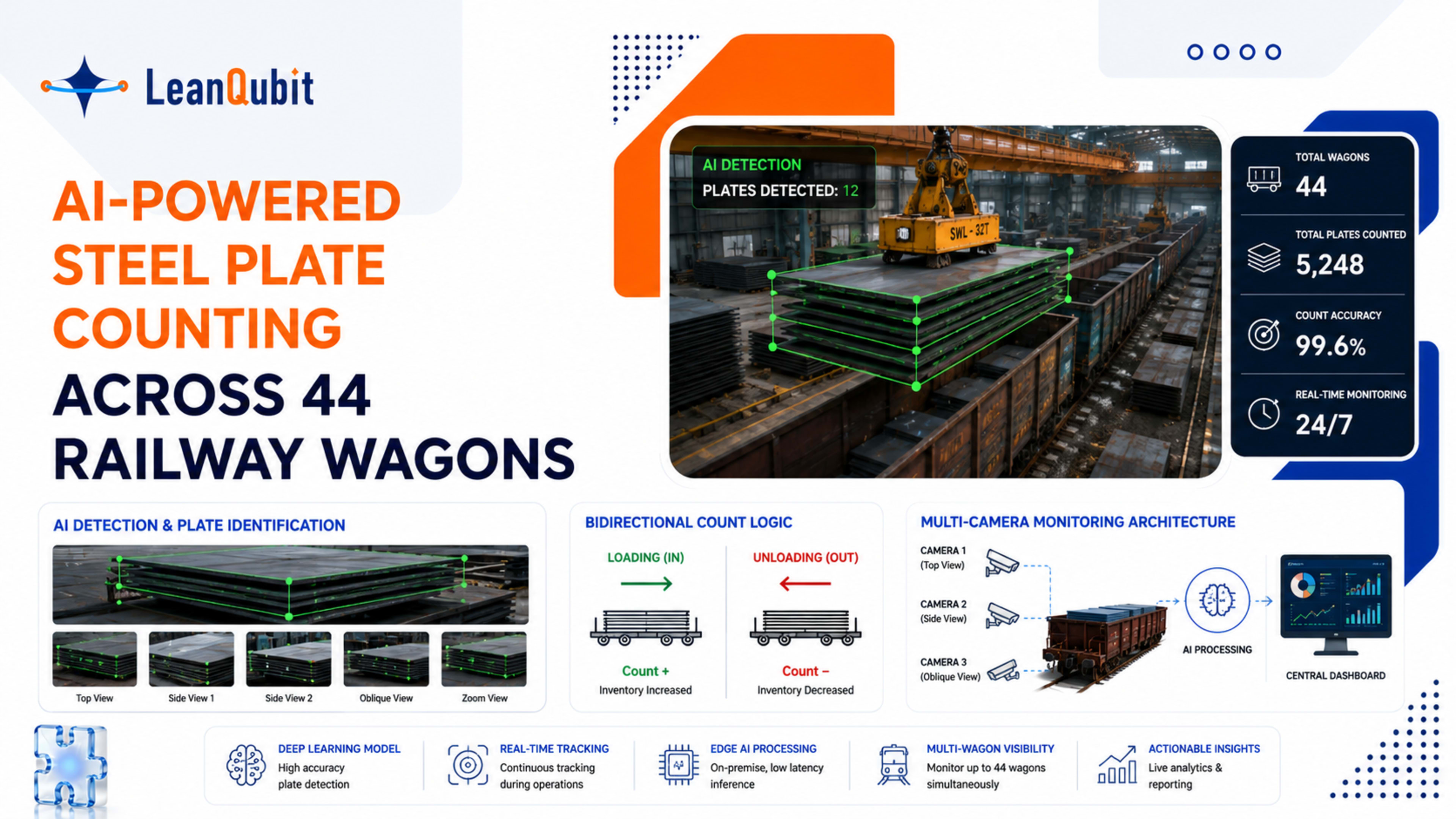
We developed and successfully demonstrated an AI-based steel plate counting system at the client's manufacturing plant using our Facto Vision solution.
The system was designed around the hardest operational edge case: one crane movement can lift up to four tightly stacked plates that may appear to a camera as a single object.
We trained a custom computer-vision model on 10,000+ images from real industrial footage, covering approximately 7–8 plate categories and multiple stacking, lighting, movement, and positioning conditions.
We used polygon segmentation and edge-based detection so the AI could reason about individual plate boundaries rather than treating a stack as one object.
We combined multi-camera monitoring, object tracking, bidirectional loading/unloading logic, wagon-wise inventory, a centralized dashboard, and a central database to digitize the counting workflow.
At LeanQubit, we developed an AI-powered computer vision system to automate steel plate counting during railway wagon loading and unloading at the client’s manufacturing facility. The operational environment involved 44 railway wagons, repeated material transfers from trailers, and loading sequences in which four wagons could be handled simultaneously. The counting step remained manual even though the physical material movement was highly mechanized.
The core technical challenge was not detecting a large steel object; it was determining how many plates were actually present when multiple plates were tightly stacked and moved together by the magnetic crane. In the hardest cases, the visible surfaces overlapped so closely that a conventional object-detection approach could treat the entire stack as a single object. We therefore engineered the vision pipeline around individual plate boundaries, using polygon annotation and a custom deep-learning computer-vision model trained on real industrial footage.
We then connected detection to motion tracking and wagon-wise inventory logic. During loading, identified plates increment the wagon count; during unloading, tracked plates decrement the count. The result is a digital counting workflow designed for continuous material movement, multiple wagons, and centralized operational visibility. The supplied project source does not provide a quantified accuracy percentage, ROI, savings figure, or processing-speed benchmark, so we intentionally do not state one.
Industry / Use Case Context
The use case sits at the intersection of steel manufacturing, material handling, railway logistics, and industrial automation. Large steel plates move from trailers to railway wagons using an overhead electromagnetic crane. The physical handling is mechanized, but the counting and inventory-reconciliation step remained manual.
Our objective was to digitize that operational gap without changing the underlying material-handling workflow: keep the existing crane-and-wagon process, but use computer vision to observe each movement, determine the plate count, and maintain a digital wagon-wise inventory.
Operational Dimension
Source-supported context
Facility scope
Steel manufacturing facility with 44 railway wagons
Material movement
Steel plates arrive on heavy-duty trailers and are moved by an electromagnetic crane
Concurrent loading
Four wagons can be loaded simultaneously in a sequence
Four wagons can be loaded simultaneously in a sequence
The crane can lift 1, 2, 3, or 4 stacked plates
AI objective
Detect, count, track, and digitally inventory plates
Monitoring model
Multi-camera monitoring with centralized dashboard and database
Business Challenge / Problem Statement
At the plant, the movement of steel plates was already mechanized, but counting remained dependent on human observation and manual reconciliation. With hundreds of plates transferred per shift and continuous activity across multiple loading zones, a small counting discrepancy could propagate into inventory mismatches, dispatch delays, and reconciliation effort.
Why manual counting became difficult
Large volumes of plates move through the operation during each shift.
Up to four tightly stacked plates may be lifted in a single crane movement.
Plate dimensions and thicknesses vary, which makes visual estimation unreliable.
Forty-four wagons require continuous wagon-wise tracking rather than one-time counting.
Multiple loading zones make it difficult for operators to maintain a consistent count across simultaneous activity.
Business Framing
The real business problem was not simply “count an object.” It was maintaining a reliable, continuously updated inventory view while material moved through a high-volume, multi-wagon process.
Existing Operational Workflow
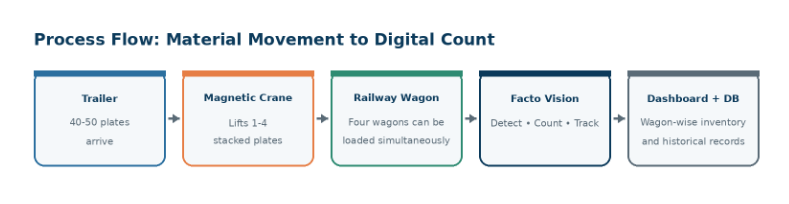
We designed the AI system around the actual material-flow sequence so that computer vision became a measurement layer on top of the physical process rather than a separate counting activity.
Steel plates arrive on heavy-duty trailers.
An electromagnetic crane lifts a stack containing one to four plates.
The crane moves the stack toward a railway wagon and places it into the wagon loading area.
Four wagons may be loaded simultaneously before the operating sequence moves to the next set of wagons.
Facto Vision observes the movement through industrial cameras, detects the individual plate boundaries, tracks the material movement, and updates wagon-wise inventory.
Presentation-ready process flow based on the documented operational sequence. Implementation facts are shown; visual styling is a recommended website presentation element.
Why the Problem Was Difficult
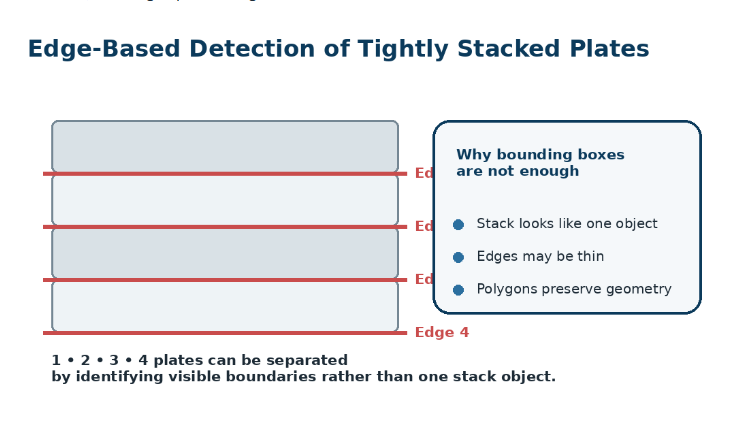
Counting a single plate is comparatively straightforward. Counting plates that are touching each other is fundamentally harder because the camera may see a stack as one continuous shape. When multiple plates overlap almost perfectly, the only evidence of separation may be a thin visible edge line between adjacent plates.
This meant the AI system had to solve a segmentation-and-boundary problem, not just a standard object-detection problem. A model that simply placed one bounding box around the full stack would not be able to determine whether the stack contained one, two, three, or four plates.
Technical edge cases
One thick plate with one visible boundary.
Two tightly coupled plates with minimal visible separation.
Three stacked plates with multiple thin edge boundaries.
Four stacked plates, representing the maximum lifting case documented in the source.
Variation in plate dimensions, thickness, surface appearance, lighting, stacking pattern, crane movement, and wagon positioning.
Recommended explanatory visualization: the model reasons about visible plate boundaries rather than treating the entire stack as one object.
Our Solution - Facto Vision
At LeanQubit, we built the solution on Facto Vision, our AI-powered industrial computer vision platform. In the corporate deck, Facto Vision is positioned around advanced AI image analysis, intelligent object recognition, real-time process insights, and machine-vision integration. For this project, we applied those capabilities to the specific problem of counting tightly stacked steel plates during material movement.
What we built
Real-time steel plate detection
Multi-camera monitoring
Edge-based stacked plate recognition
Automatic loading and unloading counting
Digital wagon-wise inventory
Configurable industrial dashboard
Scalable architecture for multiple production zones
Implementation Fact
The case-study source describes Facto Vision as the deployed AI layer for detection, counting, tracking, and wagon-wise inventory. It does not identify a specific camera vendor, inference hardware, cloud provider, or site-specific network topology, so those details are intentionally excluded.
How We Designed and Developed the AI System
We treated model development as an industrial-data engineering problem rather than a generic image-classification exercise. The dataset was built from real operational footage so that the model would learn the conditions that actually appear in the plant.
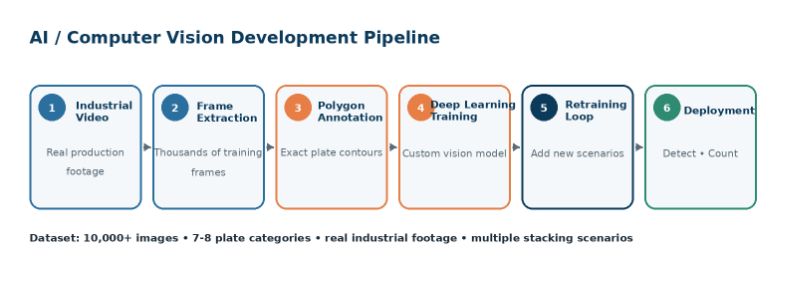
Step 1 - Industrial Video Collection
We collected multiple operational videos representing different loading scenarios. The dataset covered approximately 7–8 plate categories with variations in plate dimensions, thickness, surface appearance, lighting conditions, stacking patterns, crane movement, and wagon positioning.
Step 2 - Frame Extraction
We converted the operational videos into thousands of image frames. Each crane movement yielded multiple training samples, which increased scenario diversity while keeping the visual conditions tied to real production activity.
Step 3 - Polygon Annotation
We used polygon annotation instead of only rectangular bounding boxes. This allowed the model to learn the exact contour of each visible plate, especially where adjacent plates partially overlapped and the separation between them was represented by a thin edge.
Dataset Parameter
Documented Value
Training images
10,000+
Annotation type
Polygon segmentation
Plate categories
7–8 variants
Edge cases
Multiple stacking scenarios
Environment
Real industrial footage
Step 4 - Deep Learning Training and Retraining
We trained a custom computer-vision model to identify the visible edge of individual plates. As new operational scenarios appeared, additional data could be labeled and incorporated into retraining, creating an iterative learning loop focused on robustness in increasingly complex industrial conditions.
AI pipeline diagram for the website. The underlying sequence follows the documented collection, extraction, annotation, training, retraining, and deployment flow.
How the Algorithm Works
Intelligent Edge-Based Plate Detection
Instead of detecting the complete steel stack as one object, we designed the logic to search for the individual boundaries between plates. Once those boundaries are identified, the system can separate the stack into individual plate instances and associate those instances with movement through the counting region.
Processing sequence
Capture a frame from an industrial camera.
Detect the steel plate contours.
Identify visible edge boundaries between adjacent plates.
Separate individual plates within the stack.
Assign an object identity to the detected plates.
Track object movement across the counting region.
Update the relevant wagon inventory.
Why Polygon Segmentation Mattered
A conventional bounding box tends to collapse a tightly coupled stack into a single object. Polygon segmentation preserves contour information, which is critical for thin visible edges, partial plate visibility, overlapping geometries, and complex stacking configurations.
Counting Logic / Loading and Unloading Intelligence
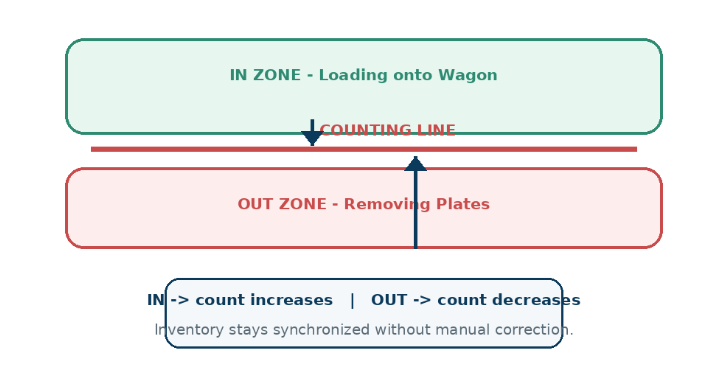
The system was designed for a dynamic logistics workflow rather than one-time counting. We support both directions of movement so the digital inventory remains synchronized as material is loaded onto or removed from a wagon.
Loading (IN)
An object enters the defined counting region.
Individual plates are identified from the stack.
The corresponding wagon count increases automatically.
Unloading (OUT)
The tracked object is recognized as it leaves the wagon.
The wagon count decreases automatically.
The inventory remains synchronized without manual correction.
Recommended website diagram for bidirectional counting: IN movement increments inventory; OUT movement decrements inventory.
Multi-Camera / System Architecture
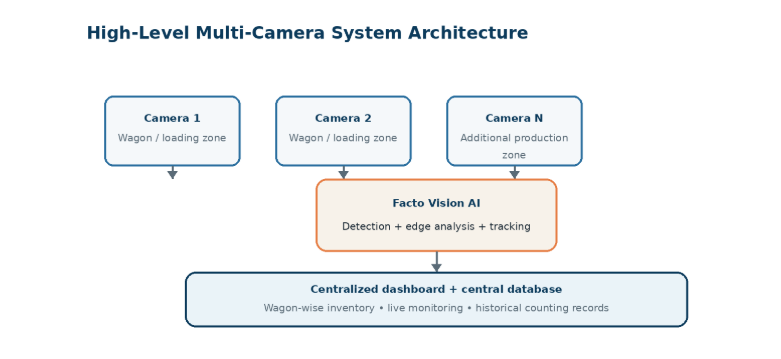
Because multiple wagons and loading zones can be active within the same operating environment, we designed the architecture for multi-camera observation and centralized visibility. The documented system components are industrial cameras, Facto Vision AI, a tracking engine, a digital dashboard, and a central database.
Component
Role in the documented solution
Industrial Cameras
Capture wagon loading operations and material movement
Facto Vision AI
Detect and count individual plates
Tracking Engine
Maintain wagon-wise inventory and object movement
Digital Dashboard
Provide live monitoring and analytics
Central Database
Store historical counting records
High-level architecture diagram. Exact camera models, network topology, and inference hardware are not specified in the source and are intentionally omitted.
Deployment / Integration Approach
The documented technology stack describes an edge/cloud-compatible architecture. At the implementation level supported by the source, cameras feed operational video into the Facto Vision AI layer, detection output is tied to movement tracking, and the resulting wagon-wise counts are surfaced through a centralized dashboard and retained in a central database.
What is explicitly supported
Industrial camera input
Facto Vision AI processing
Multi-object motion tracking
Real-time monitoring dashboard
Central historical counting database
Edge / cloud compatible architecture
Details intentionally not specified
Specific camera make/model
Inference GPU or edge hardware model
Cloud provider used for this project
PLC, SCADA, ERP, or MES integration details at the client site
Exact project duration, inference speed, or measured model accuracy
Broader LeanQubit integration context
Our Corporate Deck positions Facto Vision for integration with production lines and MES, while our IIoT Integration and Ignition capabilities support OT-IT connectivity and centralized industrial visibility. Those capabilities are part of LeanQubit’s broader portfolio; the steel-plate project source does not confirm that every one of them was part of this specific deployment.
Business Impact / Operational Benefits
The implementation moved the operation from human counting and manual tracking toward automated counting, digital inventory, and centralized visibility. We intentionally present these as supported operational outcomes rather than adding unsupported financial or performance percentages.
Before vs. After
Manual Process
Facto Vision Approach
Human counting
Automatic AI counting
Paper-based tracking
Digital inventory
Error-prone reconciliation
Real-time updates
Difficult multi-wagon monitoring
Centralized dashboard
No unloading intelligence
Bidirectional tracking
Documented operational benefits
Reduced manual counting effort
Improved inventory accuracy
Real-time wagon visibility
Digital production records
Scalable multi-camera deployment
Industry 4.0-ready architecture
Why Facto Vision Was the Right Fit
Our Corporate Deck positions Facto Vision as an AI-driven visual quality and compliance platform with advanced image analysis, intelligent object recognition, size/shape/appearance checks, real-time process insights, and integration with production lines and MES. Those capabilities align naturally with the steel-plate counting problem because the use case requires the system to understand objects visually, reason about geometry, and convert visual observations into an operational decision - in this case, a wagon count.
Need in this use case
Facto Vision alignment
Recognize individual plates
Intelligent object recognition + custom vision model
Handle difficult geometry
AI image analysis + polygon segmentation/edge analysis
Count in real time
Real-time visual processing and process insights
Support multiple operating zones
Multi-camera architecture and scalable deployment model
Create actionable operational output
Digital dashboard and wagon-wise inventory tracking
Challenges We Solved
Turned a manual counting activity into a digital, AI-assisted workflow.
Distinguished tightly stacked plates where multiple plates could visually collapse into one object.
Handled edge information that is too thin or subtle for simple bounding-box logic.
Covered multiple plate categories and real plant conditions rather than a laboratory-only dataset.
Connected object detection to motion tracking so counts correspond to actual material movement.
Added bidirectional loading and unloading logic so inventory can increase and decrease automatically.
Supported simultaneous monitoring across multiple wagons through a centralized architecture.
Key Results / Outcomes Explicitly Supported by the Sources
The supplied project source supports the following outcomes:
A working Facto Vision-based counting solution was built and documented for the railway-wagon steel plate use case.
The system supports one-to-four plate stacked lifting scenarios.
The AI development process used 10,000+ training images and approximately 7–8 plate categories from real industrial footage.
Polygon segmentation and edge-based reasoning were used to address tightly coupled plates.
Multi-camera monitoring, wagon-wise inventory, bidirectional loading/unloading logic, a centralized dashboard, and a central database are part of the documented architecture.
The solution was successfully demonstrated at the client’s plant, as specified in the project brief.
Metric Guardrail
No exact accuracy percentage, throughput benchmark, ROI, cost saving, percentage reduction, uptime improvement, or project-duration claim is included because the supplied project material does not document those figures.
Technology Stack
Layer
Technology / Approach
AI Engine
Deep Learning Computer Vision
Image Processing
Polygon Segmentation & Edge Analysis
Detection
Custom Industrial Object Detection Model
Tracking
Multi-object Motion Tracking
Interface
Real-time Monitoring Dashboard
Deployment
Edge / Cloud Compatible Architecture
Conclusion
At LeanQubit, we approached steel plate counting as an industrial AI engineering problem, not simply an image-recognition problem. The physical process already handled material movement efficiently; the gap was the lack of a reliable, continuous digital count when one crane movement could contain multiple plates that looked like a single object from the camera.
By combining custom deep-learning computer vision, polygon segmentation, edge-based plate detection, multi-object tracking, bidirectional movement logic, and a centralized multi-camera architecture, we built a Facto Vision solution that converts a difficult manual counting task into a digital operational workflow. The project also creates a foundation for broader connected-manufacturing use cases where visual intelligence, traceability, and real-time operational data need to work together.
The source material intentionally does not provide a quantified accuracy percentage, ROI figure, or cost-savings metric. We therefore keep the conclusion focused on the documented engineering outcome: automated counting, wagon-wise inventory visibility, dynamic loading/unloading intelligence, and a scalable computer-vision architecture suited to industrial operations.
Frequently Asked Questions
We detect individual plate edges rather than treating the complete stack as one object. This allows the system to count one to four tightly stacked plates during crane operations.
Yes. Our Facto Vision logic supports bidirectional counting, increasing inventory during loading and decreasing it when plates are removed.
Yes. The documented architecture is designed for simultaneous monitoring across multiple wagons using configurable industrial cameras and a centralized AI dashboard.
Polygon annotation captures precise plate geometry, which helps the model distinguish overlapping plates and thin visible boundaries that would otherwise be merged into a single detected object.
The documented dataset contains 10,000+ training images derived from real industrial footage.
The dataset covered approximately 7–8 plate categories, with variation in dimensions, thickness, surface appearance, lighting, stacking, crane movement, and wagon positioning.
Yes. Multi-camera monitoring is a documented capability of the use case, with a tracking layer and centralized dashboard/database for wagon-wise visibility.
Yes. The same object-tracking logic is used to decrease the wagon inventory when a plate leaves the counting region.
The supplied project source does not specify a camera model, GPU model, or vendor, so we have intentionally not added one.
The LeanQubit Corporate Deck positions Facto Vision for integration with production lines and MES, and our broader IIoT/SCADA capabilities support OT-IT connectivity. The supplied steel-plate project source does not confirm a specific MES/SCADA integration at the client site.