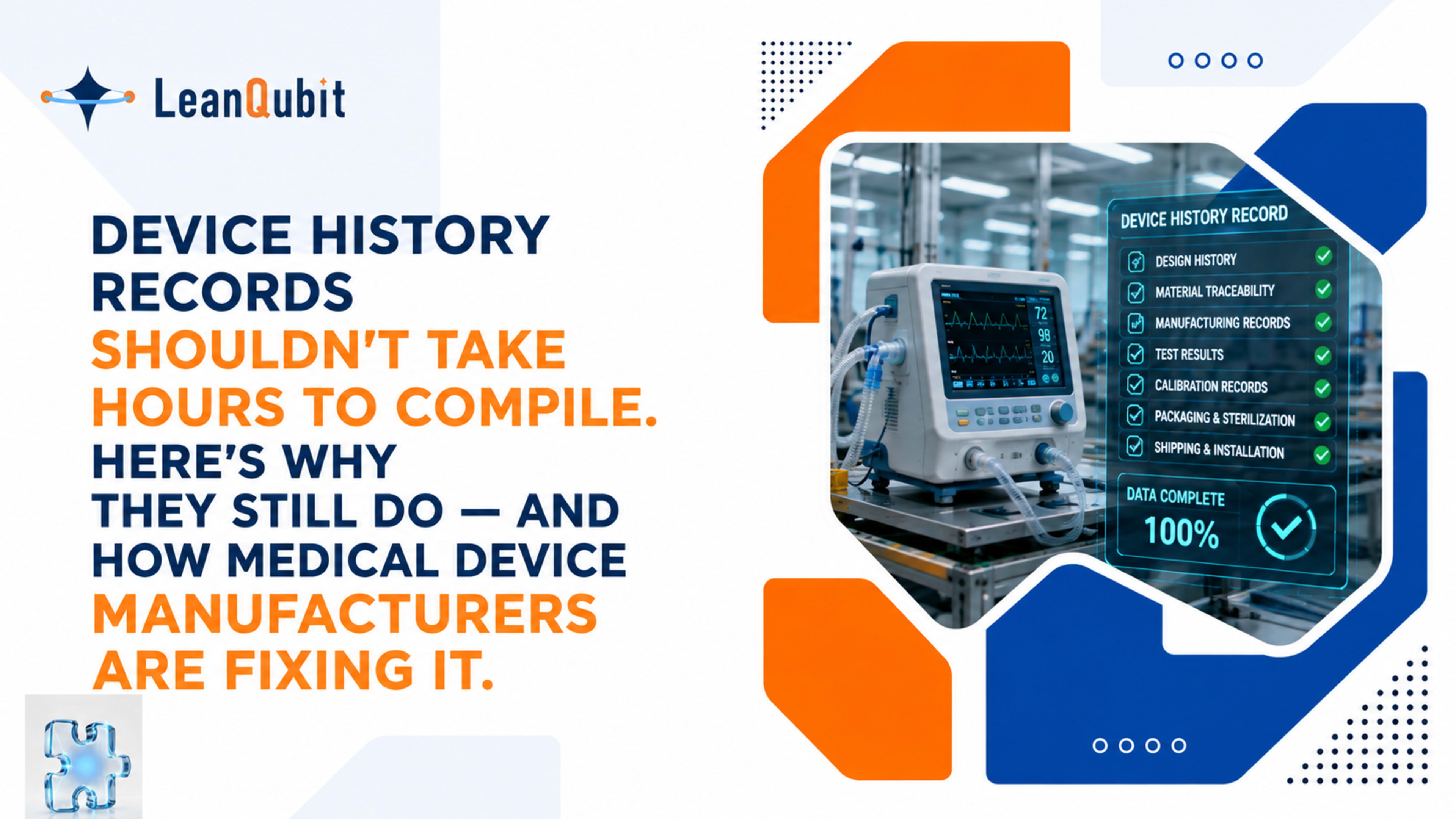
- Device History Records (DHRs) are legally required for every device unit or batch produced under FDA 21 CFR Part 820 and ISO 13485 — yet most manufacturers still compile them manually from disconnected systems, creating audit risk and operational delay.
- The DHR is not a documentation problem. It is a data connectivity problem: the information that belongs in a DHR is generated on the shop floor in real time, but it is rarely captured and structured automatically.
- Real-time OT-IT integration — connecting PLCs, sensors, and SCADA systems to a digital execution layer — eliminates the manual transcription step that makes DHR compilation slow and error-prone.
- An MES that supports real-time material traceability and genealogy can assemble the core of a DHR automatically as production progresses, rather than reconstructing it from paper logs after the fact.
- Medical device manufacturers who treat the DHR challenge as an operational data problem — rather than a documentation exercise — find that audit readiness becomes a natural by-product of connected production, not a separate preparation event.
The DHR Problem Most Medical Device Manufacturers Don’t Talk About
Most quality professionals in medical device manufacturing know exactly what a Device History Record is supposed to contain: the complete evidence that each device was manufactured in accordance with its Device Master Record — process parameters, material lot numbers, inspection results, operator sign-offs, and any deviations or corrective actions taken.
What they discuss less openly is how those records actually get assembled. In a significant number of facilities, the answer still involves a quality engineer, a stack of paper travellers, printouts from a SCADA historian, manual exports from an inspection log, and several hours of reconciliation work per batch or unit lot.
This is not a compliance failure. It is a data architecture problem wearing a compliance uniform.
DHR requirements define what must be documented. They say nothing about how the data gets there. In most plants, that “how” is still manual — and manual means slow, error-prone, and permanently audit-vulnerable.
What the Regulations Actually Require — and Where the Gap Sits
FDA 21 CFR Part 820 and ISO 13485 both require manufacturers to maintain a Device History Record for each batch or unit of finished device produced. At minimum, a complete DHR must demonstrate:
- The dates and quantities of production
- The primary identification of the components, materials, and subassemblies used
- That the device was manufactured in accordance with the Device Master Record (DMR)
- The results of acceptance activities, including inspections and tests
- Labels and packaging used
- The name of the operator or responsible individual for each significant process step
None of these requirements are unreasonable. The problem is not the requirement list — it is the number of different systems, logs, and physical records that must be consulted to satisfy it in a plant without connected data infrastructure.
In a disconnected environment, each of those requirements tends to live somewhere different: material lot numbers in an ERP or a paper receiving log, process parameters in a SCADA historian, inspection results in a standalone quality system or on a paper form, operator sign-offs on a physical traveller. The DHR then becomes a reconstruction exercise — pulling data from each source after the fact and manually verifying that it all aligns with what actually happened on the production line.
Every manual step in that reconstruction is a potential discrepancy. Every discrepancy discovered during an audit becomes a finding. Every finding requires CAPA response time that could have been applied to improving production quality instead.
Why Disconnected Data Is the Real Compliance Risk
There is a common instinct in medical device manufacturing to respond to compliance pressure with more rigorous documentation practices — more thorough forms, additional sign-off steps, more frequent manual checks. This instinct is understandable, and additional controls can reduce risk at the margins. But it addresses the symptom rather than the underlying cause.
The actual compliance risk in DHR management is not that teams are careless. It is that the data required for a DHR is generated in real time on the production floor and then reconstructed afterward from memory, paper records, and system printouts. The wider the gap between when a process step occurs and when it is formally recorded, the greater the opportunity for error, omission, or inconsistency — regardless of how diligent the team compiling the record is.
In a well-connected plant, virtually all the data that belongs in a DHR is already being generated — by PLCs, sensors, machine controllers, and operators — during the production run itself. The only question is whether that data is being structured and linked to each device unit automatically, or manually reconstructed afterward.
This is a data capture and linkage problem. Closing it requires connecting the production floor to a digital execution layer that structures data as it is generated, not retroactively assembled after the production run is complete.
The Operational Cost That Goes Beyond Audit Risk
DHR-related challenges in medical device manufacturing create operational costs that extend well beyond the compliance exposure visible during regulatory inspections.
Production throughput impact:
When DHR completion depends on manual reconciliation, a lot typically cannot be formally released until the record is complete and verified. Delays in record completion translate directly into delays in product release — and in a demand-sensitive or build-to-order environment, those delays carry a real cost measured in days, not hours.
CAPA investigation speed.
When a quality event occurs, the speed of root-cause investigation depends heavily on how quickly the relevant production data can be retrieved and correlated. In a disconnected plant, this means tracing back through each separate system and paper record to reconstruct the conditions present during the affected production run. The investigation itself can take longer than the corrective action.
Audit preparation burden.
For many medical device manufacturers, regulatory inspections or customer quality audits trigger a preparation exercise that pulls quality and manufacturing team time for days before the actual visit. This preparation time is not value-adding production activity — it is a tax imposed by an architecture where the complete production record does not exist in one queryable place.
Engineering and quality team capacity.
Every hour a quality engineer spends reconciling batch records and chasing down paper travellers is an hour not spent on process improvement, validation work, or quality system development. The cumulative cost of this time is often significantly underestimated because it is distributed across many small, routine tasks rather than visible as a single identifiable line item.
How Connected Manufacturing Intelligence Changes the DHR Equation
The architecture that eliminates manual DHR compilation is not a new document management system layered on top of an existing disconnected environment. It is a shift in how production data is captured, linked, and made available from the moment the first process step begins.
OT-IT integration at the machine level
The starting point is connecting machines, PLCs, sensors, and SCADA systems to an IT-accessible data layer. This is the OT-IT integration layer — aligning the operational technology world (machine control, process execution, sensor telemetry) with the information technology world (databases, quality systems, enterprise reporting) into a unified manufacturing ecosystem. Without this connection, process data generated by machine controllers stays isolated in those controllers and SCADA historians rather than flowing automatically into a structured production record.
A digital execution backbone
On top of connected machine data, a Manufacturing Execution System provides the operational framework that links data to context: which work order is active, which material lot is being consumed, which operator completed which step, and whether each quality checkpoint passed or triggered a deviation. This is the layer that turns a stream of machine signals into a meaningful, structured production record — one that is continuously associated with each specific device unit or batch as production progresses.
Real-time material traceability and genealogy — tracking which components went into which device, from which lot, processed on which machine, under which parameters — is the core contribution of the MES to automated DHR assembly. When this layer is active and connected, the DHR is not compiled after production is complete; it is built continuously during production.
A centralized data layer for retention and retrieval
Medical device manufacturers must retain DHRs for defined periods — typically the expected life of the device or at least two years from the date of release under applicable regulations. A secure, centralized industrial data repository that stores structured production records, maintains traceability linkages, and supports fast, specific record retrieval is what transforms the assembled DHR into a genuinely useful operational and compliance asset — one that can be called up in minutes for any unit or batch within the retention window.
AI-driven quality correlation
Once process parameters, inspection results, and genealogy data are unified in a structured data layer, analytics and AI capabilities can begin correlating production variables to quality outcomes — identifying which process conditions are statistically associated with non-conformances before they become established CAPA patterns. This is where the operational intelligence layer extends beyond compliance documentation into genuine quality improvement.
Where to Start: The Practical Path for Medical Device Manufacturers
The connected DHR architecture described above does not need to be built all at once. The practical entry point for most manufacturers is to identify the highest-frequency or highest-audit-risk DHR element and connect that single data flow digitally before expanding to the broader record.
A realistic phased approach:
Phase 1 — Digitize the highest-risk manual steps. Connect the process parameters most frequently reviewed during audits or most commonly central to CAPAs. For most device types, this means critical process parameters: temperature, pressure, speed, or torque from controlled process equipment.
Phase 2 — Build the execution linkage. Implement an MES layer that connects machine data to work orders, material lots, and operator records — so that each data point is associated with a specific device unit or batch in real time rather than linked retroactively.
Phase 3 — Unify and retain. Centralize the structured production data in a persistent, queryable data platform that supports both operational intelligence during production and long-term DHR retrieval across the required retention window.
Phase 4 — Add intelligence. Apply AI-driven analytics to the unified data set to identify process drift, quality trends, and correlation patterns that feed continuous improvement and reduce the frequency of CAPAs requiring retrospective investigation.
The technology change is only part of the transition. Equally important is aligning the quality system documentation — SOPs, validation protocols, forms, and approval workflows — with the new digital capture architecture. For regulated manufacturers, this includes verifying that the digital DHR meets the evidentiary requirements of applicable regulations, including 21 CFR Part 11 for electronic records where applicable. This is not a reason to delay — it is a reason to scope the implementation properly from the start.
Conclusion
The Device History Record is not a new requirement. It has been a regulatory constant in medical device manufacturing for decades. What has changed is the availability of connected manufacturing infrastructure capable of satisfying that requirement automatically — as a natural output of production — rather than through a separate documentation exercise assembled after the fact.
For medical device manufacturers still compiling DHRs through a combination of paper travellers, system printouts, and manual data reconciliation, the fundamental question is no longer whether connected intelligence can address this problem — it can. The more practical questions are which data flows to connect first, how to build the architecture incrementally without disrupting ongoing production and quality operations, and how to align the quality system documentation with the new digital record structure as the transition progresses.
When production data is captured in real time, linked to device genealogy as it is generated, and stored in a centralized platform that supports fast, specific retrieval, audit readiness stops being a preparation event that consumes quality team capacity before every inspection. It becomes a permanent state — a by-product of the way the plant operates every day, not a sprint triggered by an upcoming audit date.
Frequently Asked Questions
A Device History Record (DHR) is the complete set of documentation demonstrating that a medical device was manufactured in accordance with its Device Master Record. Required under FDA 21 CFR Part 820 and ISO 13485, it includes production dates, quantities, material lot numbers, process parameters, inspection results, and operator records for each device unit or batch. DHRs are among the primary documents reviewed by regulatory inspectors and customer quality auditors — making their completeness and accuracy a direct compliance obligation, not a best practice.
The risk of manual DHR compilation is not about team competence — it is about the data capture architecture. When process data is generated in real time on the production floor but recorded manually and reconciled after the fact from separate systems and paper records, the opportunity for transcription error, data omission, and timing discrepancy is embedded in the process itself. Regulatory findings related to DHR inconsistencies frequently trace back to this structural gap rather than to deliberate noncompliance or inadequate attention.
An MES provides the digital execution layer that links production data to operational context: which device unit or batch was produced under which work order, using which material lot, through which process steps, under which parameters, and with which inspection outcomes. This linkage — particularly real-time material traceability and genealogy — is what allows the DHR to be assembled automatically and continuously during production rather than reconstructed manually from multiple sources after the production run is complete.
Not necessarily. An OT-IT integration approach connects existing machine-level systems — PLCs, SCADA historians, machine controllers — to a digital execution and data layer without requiring replacement of installed infrastructure. The integration layer translates machine signals and process data into structured records that feed an MES and data platform, while the existing ERP system continues to handle planning, scheduling, and material management. The critical requirement is that an integration architecture exists to connect these layers into a unified data flow.
A centralized data repository provides the long-term structured storage, retention, and queryability that DHR regulations demand. Rather than relying on paper files, SCADA historian archives, and ERP records that must be manually reconciled for each inspection, a unified data platform allows the complete production record for any lot or device unit to be retrieved and presented as a structured, auditable record within seconds. This directly reduces audit preparation time and eliminates the risk of incomplete or inconsistent records caused by data fragmentation across multiple systems.
OT-IT integration — connecting machine-level operational technology to IT-accessible databases and execution systems — is the foundational requirement for automated DHR data capture. Without this connection, process parameters generated by PLCs and sensors remain stranded in machine controllers and SCADA historians, requiring manual export, transcription, and reconciliation before they can appear in a DHR. With OT-IT integration in place, the same data flows automatically into the production record as it is generated — eliminating the most error-prone and time-consuming step in manual DHR compilation.
Ready to explore what connected manufacturing intelligence looks like in a medical device facility? Book a free scoping call with LeanQubit’s engineers to discuss how FactoMES, FactoLake, and OT-IT integration can address the data capture and traceability challenges specific to your plant — and build a DHR process that works continuously, not just before inspections.