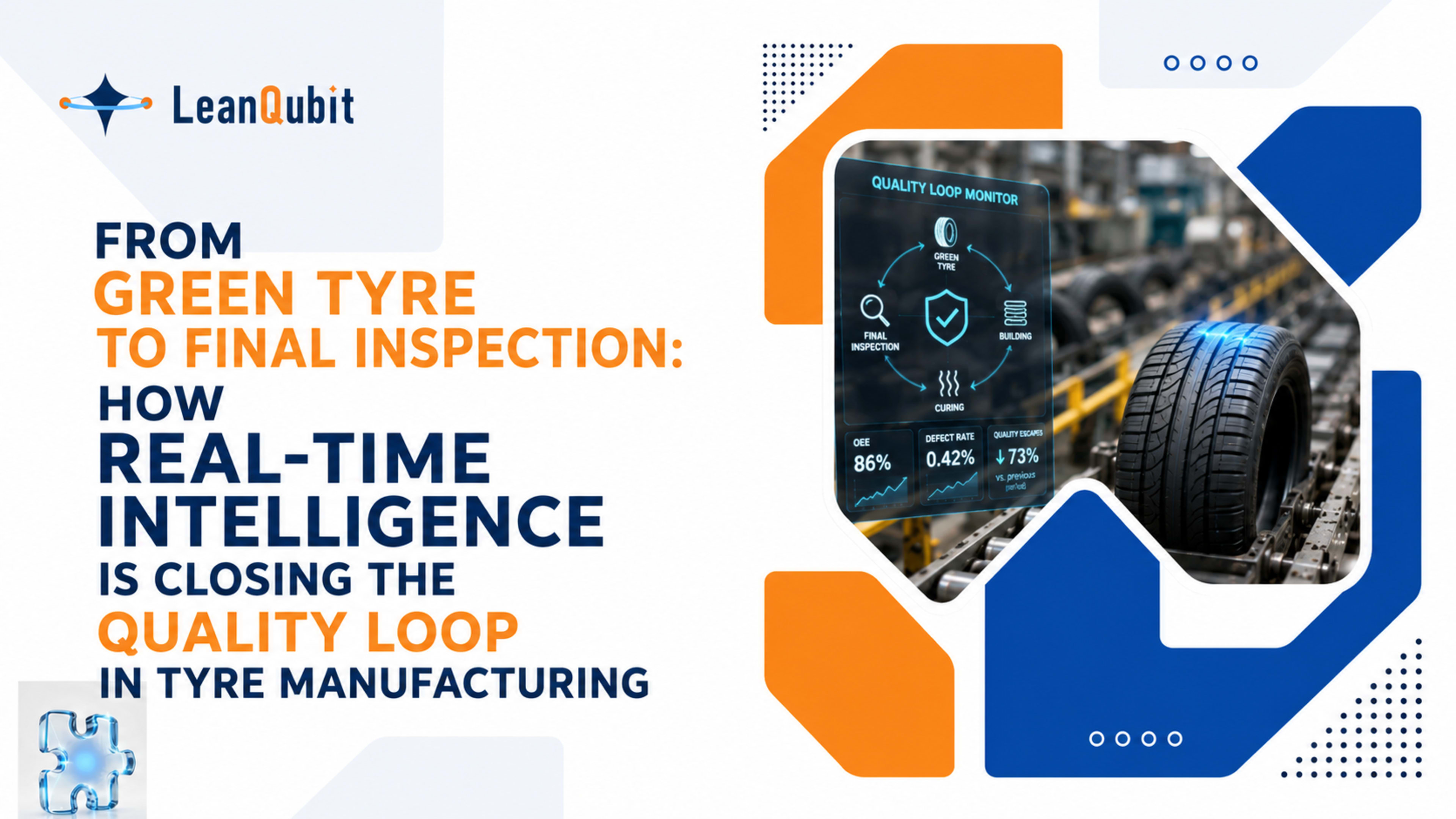
- Quality defects in tyre manufacturing are often introduced at the building or mixing stage but detected only at final inspection — multiplying the scrap and rework cost embedded in every reject.
- Real-time process monitoring across building machines and curing presses enables faster root-cause analysis, compressing quality investigations from days to hours.
- AI-powered visual inspection catches the subtle structural and surface defects — bead distortions, tread voids, sidewall anomalies — that manual inspection consistently misses at production speed and scale.
- Connecting MES with IIoT-instrumented curing presses reveals press utilisation gaps and cure cycle deviations that are among the most undertracked OEE contributors in tyre plants.
- Tyre manufacturers who unify process data from compound mixing through final inspection into a single operational data platform can close the quality loop and move from reactive fire-fighting to proactive process control.
A tyre is not a simple product. Before it leaves the factory floor, it passes through compound preparation, component assembly, green tyre building, curing and vulcanisation, and a series of quality inspections — each stage dependent on precise parameters and tight process control. A deviation at any point, however minor, can result in a product that fails uniformity tests, exhibits structural weakness, or — worst of all — reaches the end customer.
Yet despite the technical complexity of the production process, many tyre manufacturers still rely on a fundamentally disconnected quality approach: parameters recorded manually, inspections performed at isolated stations, and defect data that rarely feeds back into upstream process decisions in real time. When quality escapes happen — and they do — the investigation becomes a fire-fighting exercise rather than a systematic correction.
This is the problem that modern industrial AI and real-time manufacturing intelligence are beginning to solve. And for tyre manufacturers operating under intense pressure on quality, cost, and throughput, the opportunity has never been more strategically significant.
Why Tyre Manufacturing Is a Quality Control Challenge Unlike Any Other
Tyre manufacturing sits at a unique intersection of material science, mechanical engineering, and high-volume production. The product must meet extremely tight safety and performance standards — dimensional tolerances, uniformity indices, dynamic balance — while being produced at scale across multiple shifts and dozens of product variants.
The process is also inherently multi-stage. Raw materials enter as rubber compounds, textiles, steel belts, and beads. These are transformed through calendering, extrusion, cutting, and assembly into a green tyre that is then cured under high heat and pressure inside a precision mould. Each of these transitions creates a potential quality risk point.
The challenge is that defects introduced at one stage often become detectable only at a later stage — sometimes not until final inspection, or in the worst case, after shipment. A misaligned belt ply may not trigger any alarm during building but will show up as a uniformity deviation during post-cure testing. By that point, the tyre cannot be reworked. It becomes scrap — with all the material, energy, and machine time embedded in it written off entirely.
This delayed detection dynamic is one of the central quality cost drivers in tyre manufacturing. It is precisely the problem that real-time process intelligence is designed to address.
The gap between where defects are created and where they are detected is the single most expensive quality control problem in most tyre plants. Bridging that gap with connected data is the foundational objective of modern manufacturing intelligence.
The Data That Exists — But Is Not Connected
Walk through a modern tyre plant and you will find no shortage of data sources. Curing presses log temperature curves, bladder pressure, and cure time. Building machines record drum speed, component splice counts, and ply tension. Extrusion lines monitor compound temperature and output rate. SCADA systems capture PLC signals across dozens of machines.
What you typically will not find is all of this data flowing into a single coherent operational picture — one that allows a quality engineer or plant manager to trace a batch of tyres through every process step and correlate process parameters with the outcomes they produced.
This is the data silo problem in its most common form: not a lack of data, but a failure of integration. Each system captures what it knows. None of them communicate in a way that enables cross-stage analysis or real-time process correlation. The consequences are predictable:
- Quality investigations are slow because data must be manually retrieved from multiple systems and correlated by hand
- Process deviations in curing go unnoticed until post-cure inspection results reveal a recurring pattern
- Root-cause analysis is retrospective rather than proactive, meaning scrap is already generated before the problem is understood
- Opportunities for process optimisation are missed because no one has visibility across the full production sequence
Breaking down these silos — connecting machines, process systems, and quality data into a unified operational platform — is the foundational step in modernising tyre manufacturing quality control. It is also the prerequisite for every AI-driven capability that follows.
Real-Time Process Monitoring: From Building Machine to Curing Press
The curing press is the most capital-intensive asset in a tyre plant. It is also, for most manufacturers, one of the least monitored in terms of process quality intelligence. Press temperatures are logged, and alarms trigger on out-of-range conditions, but the subtler degradation patterns — gradual bladder wear, mold release inconsistency, steam supply fluctuation — often go undetected until they produce a quality deviation or an unplanned breakdown.
Real-time IIoT connectivity changes this. When curing presses are instrumented with sensors that continuously stream temperature uniformity data, cycle time deviation, and bladder pressure profiles to a centralised monitoring platform, patterns become visible that would otherwise be buried in historical logs that nobody reviews until something goes wrong.
Similarly, at the building machine level, real-time monitoring of ply application tension, drum expansion pressure, and splice interval consistency allows process engineers to identify deviations in component application before those deviations reach the press. This shifts quality control from the inspection stage — where defects have already been created — to the process stage, where they can be corrected or prevented.
When this process-level monitoring is connected through a Manufacturing Execution System that tracks each tyre by its unique identifier from building through curing and inspection, the result is genuine end-to-end traceability. Every tyre has a complete data record. Every deviation has a timestamp and a machine context. Root-cause investigations that previously took days are compressed into hours.
Start by instrumenting your curing presses for real-time temperature uniformity and cycle time monitoring. Cure quality is directly tied to these parameters, and even small deviations compound into measurable uniformity defects. This is typically the fastest ROI entry point in tyre plant process monitoring.
AI-Powered Visual Inspection: Finding What Human Eyes Miss
Even with excellent process monitoring, some defects will only become detectable at the physical inspection stage. Tyre inspection has traditionally been performed by trained visual inspectors — skilled workers who examine each tyre for surface defects, dimensional irregularities, and visible structural anomalies. This approach has fundamental limitations at production speed.
Inspection fatigue is real. Consistency degrades across long shifts and across inspectors. Low-contrast defects — shallow tread surface bubbles, minor sidewall indentations, early indicators of ply separation — are difficult to detect reliably with the naked eye under variable lighting conditions. And if the inspection station itself becomes a bottleneck, takt time improvements elsewhere in the plant deliver no benefit.
AI-powered visual inspection addresses each of these constraints. By deploying industrial cameras at key inspection points — post-cure, post-trimming, and final audit — and running inference through trained computer vision models, tyre manufacturers can achieve consistent, high-speed defect detection that does not fatigue, does not vary across shifts, and does not miss the subtle anomalies that routinely escape manual inspection.
The use cases in tyre manufacturing are highly specific and practically valuable:
- Tread surface inspection: Detection of flow lines, under-fill voids, surface bubbles, and compound contamination across the full tread width
- Sidewall inspection: Identification of surface indentations, mold release residue, sidewall porosity, and labelling or marking defects
- Bead area inspection: Detection of bead distortion, bead wire exposure, and surface defects at the rim interface where tyre-to-wheel seal integrity is critical
- Inner liner inspection: Identifying porosity, contamination inclusions, and surface indicators of cure quality issues before assembly The output of these inspection systems feeds directly into the quality data record for each tyre, enabling statistical process control at the product level and generating the defect trending data that engineers need to close the quality loop upstream.
Closing the Loop: From Inspection Data Back to Process
The most powerful application of connected quality intelligence is not the detection of individual defects — it is the prevention of the next batch carrying the same defect. When inspection data from post-cure AI systems is connected back to the process parameters — machine settings, cure conditions, material batch traceability — that produced those tyres, a corrective feedback loop becomes possible at a speed that manual systems simply cannot match.
If the AI inspection system identifies a pattern of tread surface voids concentrated in tyres from a specific press, and the platform can correlate that pattern with a process parameter — for example, a gradual decline in bladder pressure consistency over the previous 48 hours — the root cause becomes identifiable without a lengthy investigation. The corrective action is specific, targeted, and fast.
This is the shift from reactive to proactive quality management. It requires not just data collection, but data integration — across process systems, quality inspection, and machine monitoring — in a unified operational data platform that enables analysis across production stages and across time. Three capabilities need to come together:
- End-to-end traceability — every tyre uniquely identified and tracked from building through final inspection
- Real-time process data — IIoT connectivity feeding machine parameters into a centralised monitoring system
- AI inspection integration — defect classification data linked to the same tyre-level production record
When these three elements are in place, the quality investigation workflow transforms. Instead of assembling data manually from disconnected systems, engineers query a unified record. Patterns surface automatically. Corrective actions are evidence-based. And the organisation builds a continuously growing dataset that trains both its AI models and its process knowledge over time.
OEE Visibility Across the Tyre Production Process
Tyre manufacturing plants frequently report OEE below what is achievable — not because their machines are fundamentally unreliable, but because their downtime events are poorly captured, their performance losses are poorly tracked, and their quality rate is measured too late in the process to drive upstream improvement.
Real-time production monitoring — connecting building machines, curing presses, and inspection stations through a unified MES — gives plant managers the OEE visibility they need to act on these losses systematically. When downtime events are automatically captured and categorised as they occur, performance deviations are flagged in real time, and quality reject data is linked to specific machines and shifts, the path to OEE improvement becomes clear and data-driven rather than based on end-of-shift manual logs.
For curing operations specifically, press utilisation is often lower than planned due to a combination of unplanned breakdowns, schedule-driven idle time, and quality holds. Tracking this through real-time MES data enables planners to schedule maintenance interventions before failures occur, optimise press allocation across the production schedule, and reduce the queue time between building and curing that erodes capacity without showing up as a visible downtime event.
The cumulative effect — tighter process control, fewer quality escapes, reduced unplanned downtime, and faster decision-making across the plant — is an OEE improvement that is both measurable and sustainable. Unlike one-time efficiency initiatives, it is grounded in continuously improving data rather than a single project output.
The Platform Foundation: Why Architecture Matters
Implementing individual monitoring tools at the press level or a standalone inspection camera at the end of the line will produce some value. But the compounding benefits described above — closed-loop quality correction, cross-stage root-cause analysis, and OEE visibility from building through inspection — only emerge from an integrated platform architecture.
That architecture needs to address several practical requirements specific to the tyre manufacturing environment:
- High-frequency data ingestion from legacy PLC-controlled curing presses using industrial protocols — OPC-UA, Modbus, and similar — without requiring press replacement
- Unique tyre-level traceability linking process data to physical product records as tyres move through building, curing, and inspection
- Scalable storage that can handle the volume of sensor data generated by dozens of presses running multiple cures per hour across extended production periods
- Analytics that can surface cross-stage correlations — connecting inspection outcomes to upstream process parameters — without requiring manual data assembly by engineers
- Secure access architecture that allows quality engineers, process engineers, plant managers, and IT teams to access the data they need without compromising OT system integrity
This is the architecture that industrial data lake and MES platforms are designed to support — and the reason why the platform layer is as important as any individual monitoring or inspection capability deployed on top of it.
Conclusion
Tyre manufacturing is a process-intensive business where the cost of poor quality — in scrap, rework, downtime, and the ultimate risk of a field failure — is simply too high to manage with disconnected, retrospective quality systems. The data to run these operations better already exists in most plants. The challenge is connecting it, interpreting it in real time, and using it to drive faster, more targeted process decisions.
Real-time process monitoring, IIoT connectivity, AI-powered visual inspection, and unified MES platforms are not emerging concepts. They are production-ready capabilities that progressive tyre manufacturers are deploying today to protect quality, improve OEE, and build the operational intelligence they need to compete in a market where product consistency and production efficiency are both non-negotiable.
The gap between where defects are created and where they are detected is a solvable problem. Closing it is not a technology challenge — it is a data architecture and integration challenge. And the manufacturers who close it first will operate with a structural advantage that compounds over time.
AI-powered visual inspection systems are effective at detecting a wide range of tyre surface and structural defects including tread voids and flow lines, sidewall indentations and surface porosity, bead distortion, inner liner contamination, and labelling or marking defects. These systems are particularly valuable for low-contrast defects that are difficult to detect reliably through manual visual inspection at production speeds — defects that often pass unnoticed until they cause downstream quality or safety issues.
A tyre plant MES connects process data from building machines, curing presses, and inspection stations to a unified production record for each individual tyre. This enables end-to-end traceability, real-time downtime and OEE tracking, and the data foundation needed to correlate inspection outcomes with upstream process parameters. When a quality problem occurs, the MES allows engineers to immediately pull the process record for the affected tyres rather than spending days assembling data from disconnected systems.
Yes. Modern IIoT integration approaches allow sensors and data collection gateways to be deployed on existing equipment without requiring press replacement. Industrial IoT platforms can connect legacy PLC-controlled curing presses to a centralised data pipeline using standard industrial communication protocols, enabling real-time process monitoring on the existing installed equipment base. This is one of the key advantages of OT–IT integration platforms designed specifically for the industrial environment.
Closing the quality loop means that defect information detected at inspection is automatically connected back to the specific process parameters — machine settings, cure cycle data, material batch traceability — that produced those tyres. This allows engineers to identify the upstream root cause of a quality issue and correct it before the next production run, rather than discovering the problem only after substantial scrap has already been generated. It transforms quality management from a post-production audit activity into a real-time corrective feedback system.
The most practical starting point is typically IIoT connectivity and real-time monitoring on the highest-impact equipment — usually the curing press — combined with MES-level traceability linking each tyre to its process record from building onwards. This provides the data foundation that all subsequent AI and analytics capabilities build on. Adding AI-powered visual inspection at the post-cure inspection station is a natural second step, as it immediately generates the defect classification data that makes upstream process correlation possible.
Ready to explore what connected quality intelligence could look like in your tyre plant? Talk to the LeanQubit team about how FactoVision, FactoMES, and FactoIQ can help you build an end-to-end process monitoring and quality inspection solution tailored to tyre manufacturing operations.