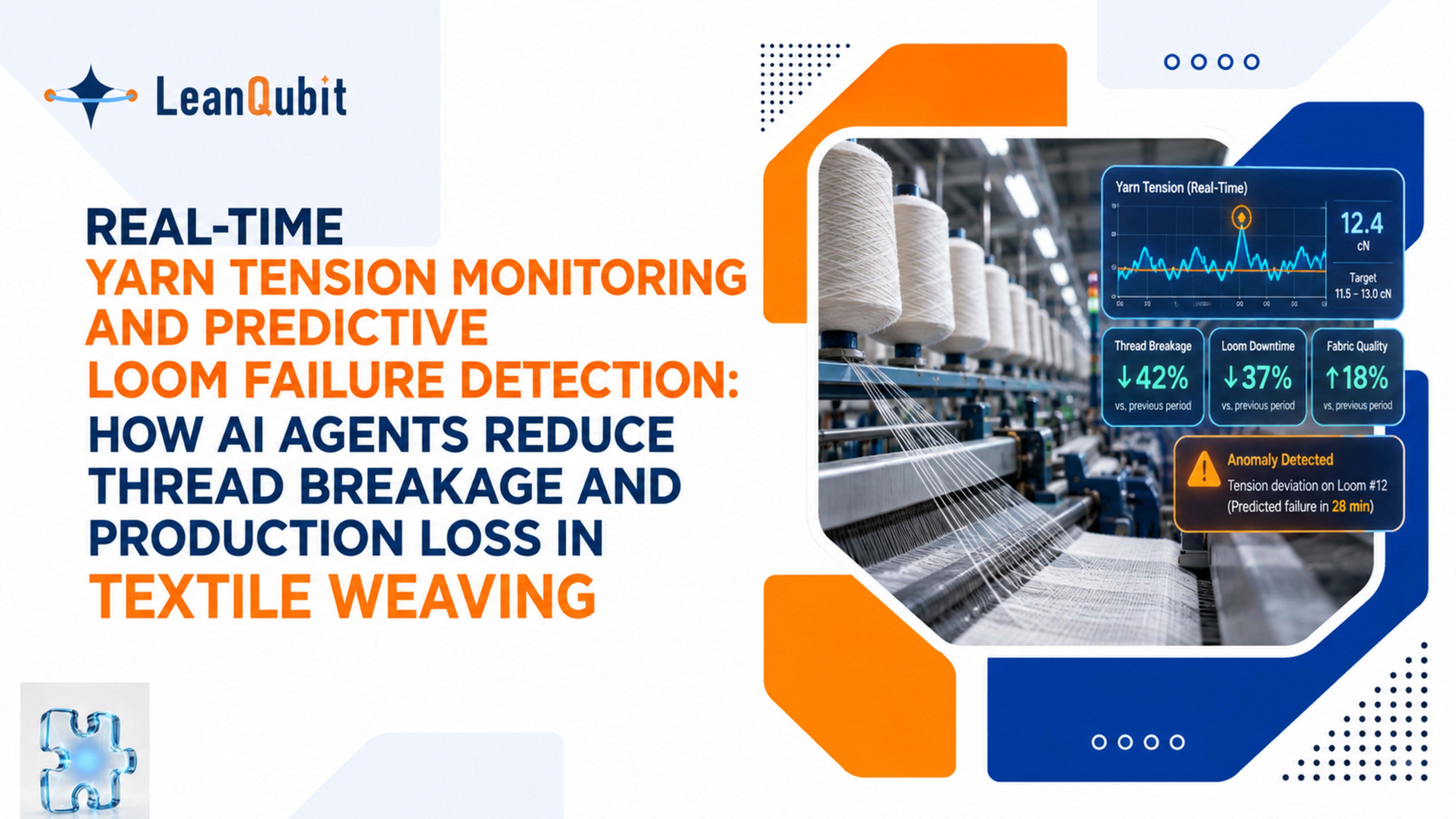
- AI-powered yarn tension monitoring detects thread-breakage risks and equipment degradation in real time, helping reduce unplanned downtime, production losses, and manual interventions.
- Consistent tension control minimizes tension-related defects and scrap, while predictive insights help operators spend less time troubleshooting and more time optimizing production efficiency.
- Predictive maintenance shifts textile mills from reactive repairs to planned interventions, reducing maintenance costs and enabling scalable implementation based on measurable operational value.
In modern textile weaving mills, a single thread breakage doesn’t just waste material—it triggers a cascade of operational disruptions. The loom stops. Operators must locate and correct the issue. Production resumes, but quality may already be compromised on the partially completed fabric. For high-volume weaving operations running dozens of looms simultaneously, these micro-interruptions accumulate into substantial lost throughput and quality rework.
The textile weaving industry has long grappled with thread breakage as an unavoidable consequence of production. Yarn characteristics vary batch to batch. Equipment wear changes loom behavior gradually and unpredictably. Environmental conditions—humidity, temperature, static electricity—fluctuate across the mill floor. Operators become skilled at managing these variables through intuition and experience, but intuition doesn’t scale across 100 looms operating 24/7. And when experienced operators retire, that tribal knowledge walks out the door.
Real-time yarn tension monitoring paired with AI-driven predictive maintenance agents fundamentally changes this equation. By continuously analyzing tension data from active looms and correlating it with equipment performance history, machine learning models can predict which threads are likely to break within the next hour—sometimes days in advance—and flag equipment degradation before catastrophic failure occurs. The result: fewer interruptions, more consistent fabric quality, and dramatically improved operational efficiency.
Why Yarn Tension Matters in Textile Weaving
Yarn tension directly controls the quality of woven fabric. When tension is optimal, warp and weft threads interlace uniformly, creating fabric that is strong, dimensionally stable, and aesthetically consistent. When tension drifts—too high or too low—defects emerge immediately: loose picks (weft floats), tight picks (fabric puckering), broken yarns, and uneven color absorption in the case of dyed fabrics.
Traditionally, tension is managed through mechanical systems: tension devices, let-off mechanisms, and take-up equipment designed to hold yarn at a target tension range. However, these mechanical systems operate within fixed parameters and respond only after tension deviation has already occurred. By the time an operator notices a problem visually or through feel, the loom may have already produced dozens of meters of defective fabric.
Moreover, yarn characteristics change continuously throughout production:
Yarn diameter variation affects how much tension the mechanical system applies: Yarn from different suppliers or even different bobbins from the same supplier can have slightly different diameters, twist, and crimp characteristics. A bobbin that starts production with nominal diameter gradually decreases in diameter as yarn is consumed—this unwinding diameter change means the actual tension applied by a fixed let-off mechanism changes over the course of a bobbin.
Environmental drift is relentless: As ambient humidity rises or falls, yarn absorbs or releases moisture, changing its elastic properties and strength. Temperature swings affect fiber crimp and loom frame geometry. Static electricity buildup—especially problematic in low-humidity conditions—can cause yarns to adhere to parts or repel from guides, disrupting normal tension.
Equipment wear is inevitable: Over thousands of production cycles, loom components degrade: guide rollers flatten, heddles become slightly bent, reed wires relax. Each small change incrementally alters the tension environment. Without visibility into cumulative wear, operators may not recognize that a loom has drifted out of specification until quality issues or breakages escalate.
Yarn quality variation from fiber preparation stages upstream carries through to the weaving shed. Irregularities in yarn count, neps (fiber knots), thick and thin places—all affect breakage risk. Spotting this variation in real time and adjusting loom parameters accordingly is beyond the capacity of manual monitoring.
The Hidden Cost of Thread Breakage and Reactive Maintenance
The direct costs of thread breakage are well understood: lost yarn, slower production, rework. But the operational costs run deeper.
Each thread breakage in a multi-loom weaving shed demands immediate attention. An operator must stop the loom (or detect the breakage from automated sensors), locate the break, rethread the warp, and restart the loom. Depending on loom complexity, this can take 5 to 20 minutes per incident. In a weaving mill with 50 looms and an average breakage rate of 2-3 per loom per shift, that’s 100+ manual interventions per shift—hours of labor devoted to reactive troubleshooting rather than proactive optimization.
Unplanned equipment failures compound the problem. Loom bearings wear under high-speed vibration. Motors degrade. When a bearing fails or a motor stops, the entire loom goes down until maintenance arrives and makes repairs. This isn’t a 20-minute inconvenience—it’s a 2-8 hour outage that halts production and may require starting production on a backup loom, causing schedule delays and potential delivery penalties.
Schedule disruptions have systemic ripple effects. Textile mills typically operate under tight delivery windows. A 4-hour unplanned downtime on Tuesday may shift production of an order from one customer to Wednesday, delaying that customer’s shipment. Supply chain partners—cutters, apparel manufacturers—downstream from the mill depend on reliable delivery. When textile mills miss dates, they lose margin through penalties or lose future orders to competitors with better reliability.
Quality losses compound these costs. Thread breakage and tension drift don’t always stop the loom—sometimes they produce defective fabric that passes initial inspection and is discovered later by the customer. This triggers returns, rework, and reputational damage that can be expensive to remedy.
How Real-Time Yarn Tension Monitoring Prevents Breakage
Modern yarn tension sensors installed on looms collect data continuously. These sensors typically measure tension via load cells, dancer arm position, or yarn velocity—providing real-time readings at 10-100 Hz frequency (depending on sensor type). Rather than relying on this data for a single point-in-time alarm (e.g., “tension is high, alert operator”), AI-powered monitoring systems analyze the entire temporal pattern of tension behavior.
Pattern Recognition in Tension Data: AI models trained on historical tension data from thousands of looms learn to recognize patterns that precede thread breakage. These patterns often include:
Trending upward: Tension gradually increasing over 10-30 minutes (indicative of yarn diameter reduction on unwinder or mechanical drift)
Oscillation and instability: Rapid, high-amplitude fluctuations (suggesting bearing wear or yarn irregularity)
Sudden spikes: Brief, sharp increases followed by return to normal (often a sign of yarn neps or guide alignment drift)
Tension asymmetry: Different tension across warp sections (warp skewing or heddle wear on one side)
By correlating these patterns with subsequent breakage events in the historical record, machine learning models learn which tension signatures predict imminent failure. The AI system can then issue a preventive alert 15 minutes to several hours before a predicted breakage occurs, giving operators time to adjust tension, inspect yarn, or perform preemptive maintenance.
Actionable Guidance:
Unlike simple threshold alarms, AI-driven systems can recommend specific corrective actions based on the type of tension deviation detected:
- If tension is trending high due to unwinder diameter reduction: Recommend checking bobbin weight and potentially replacing the bobbin if it’s near empty.
- If tension oscillates due to bearing wear: Recommend a maintenance inspection of tension rollers or let-off bearings.
- If tension shows asymmetry: Recommend checking warp alignment or heddle condition on the affected side.
This specificity reduces the trial-and-error that operators otherwise undertake when responding to a breakage after the fact.
Predictive Maintenance for Loom Components: Beyond Tension
While yarn tension monitoring addresses the immediate breakage challenge, predictive maintenance agents extend protection to the equipment itself. Loom components fail according to wear patterns that, with sufficient data, become predictable.
MaintIQ and Loom Health Monitoring:
LeanQubit’s MaintIQ predictive maintenance agent ingests sensor data from across a loom—vibration sensors on bearings, temperature sensors on motors, load sensors on take-up mechanisms—and learns the degradation signatures of each component type. When a bearing begins to wear, vibration energy at specific frequencies rises. When a motor begins to lose efficiency, current draw increases or temperature climbs. The AI model detects these early-warning signatures and predicts, with quantified confidence, when failure is likely to occur (e.g., “bearing failure predicted in 5-7 days; confidence 89%”).
With this prediction in hand, maintenance teams can schedule bearing replacement during planned downtime rather than discovering failure mid-shift and executing an emergency repair that disrupts production and may introduce temporary quality issues.
For textile mills operating large numbers of looms, predictive maintenance dramatically improves equipment availability and reduces unplanned downtime.
- Average loom downtime reduction: 20-35% in similar manufacturing settings
- Maintenance labor efficiency: Maintenance hours shift from reactive emergency work to planned, efficient interventions
- Parts supply optimization: Rather than discovering mid-failure that you need a bearing, you can order it in advance and schedule installation proactively
Integrating Real-Time Data with Production Scheduling: FactoMES and Operational Coordination
Knowing that a thread breakage is likely to occur within the next 3 hours, or that a loom bearing needs attention in 5 days, is valuable only if this intelligence reaches production planners and schedulers.
LeanQubit’s FactoMES manufacturing execution system integrates real-time production data, equipment status, and quality metrics into a single operational layer. When MaintIQ predicts an imminent maintenance need on a particular loom, FactoMES can automatically:
- Flag the affected loom in the production dashboard so planners see it's at elevated risk
- Suggest moving scheduled production jobs off the at-risk loom to other available looms (if capacity exists)
- Notify maintenance teams of the predicted need with sufficient lead time to prepare materials and schedule intervention during a natural production pause
- Track the intervention and verify that the predicted issue was indeed addressed, enabling continuous refinement of the prediction model
Reducing Quality Losses Through Consistent Tension
Beyond preventing breakage and downtime, stable yarn tension directly improves fabric quality. Tight control of tension variance reduces the defects that tension drift causes:
- Fewer loose picks and tight picks: Consistent tension yields uniform fabric appearance and hand (feel)
- Improved dimensional stability: Fabric shrinks and stretches more uniformly during finishing and use
- Better color absorption: In dyed fabrics, uniform tension during weaving improves dye penetration uniformity
- Reduced rework: Less defective fabric means less time spent in quality rework processes
For mills competing on quality or serving customers with strict quality requirements (automotive textiles, technical fabrics, high-end apparel), this quality improvement directly impacts profitability. Fewer returns from customers. Lower rework costs. Better on-time delivery. These margins compound.
Reducing Quality Losses Through Consistent Tension
Beyond preventing breakage and downtime, stable yarn tension directly improves fabric quality. Tight control of tension variance reduces the defects that tension drift causes:
- Fewer loose picks and tight picks: Consistent tension yields uniform fabric appearance and hand (feel)
- Improved dimensional stability: Fabric shrinks and stretches more uniformly during finishing and use
- Better color absorption: In dyed fabrics, uniform tension during weaving improves dye penetration uniformity
- Reduced rework: Less defective fabric means less time spent in quality rework processes.
For mills competing on quality or serving customers with strict quality requirements (automotive textiles, technical fabrics, high-end apparel), this quality improvement directly impacts profitability. Fewer returns from customers. Lower rework costs. Better on-time delivery. These margins compound.
Overcoming Implementation Barriers: From Legacy Systems to AI-Ready Operations
A common concern among textile mills considering yarn tension monitoring and AI predictive maintenance is integration with legacy loom equipment. Many mills operate looms that are 10-20 years old and lack integrated sensors or digital systems.
Modern installations address this through retrofit sensor packages: wireless tension sensors, vibration accelerometers, temperature sensors, and motor current sensors can be added to legacy looms without major modifications. These sensors stream data via edge gateways to a cloud-based or on-premises data platform, where machine learning models run in real time.
LeanQubit’s IoT integration capabilities are designed specifically to bridge this challenge. Our platform connects across heterogeneous mill environments—mixing modern sensor-equipped looms with legacy equipment, various SCADA systems, legacy ERP data, and quality systems—into a unified data model. The FactoLake data platform centralizes all this information, and the FactoIQ analytics engine trains models on the aggregated dataset.
Implementation typically follows a phased approach: pilot on 5-10 looms first, validate the value, then expand across the mill floor. Most mills see measurable improvements within the first 30-60 days: reduced breakage rates, faster detection of emerging quality issues, and elimination of several hours of daily manual intervention.
Real-World Context: Yarn Tension Monitoring in Practice
Consider a hypothetical 80-loom weaving mill producing cotton and cotton-blend fabrics for apparel manufacturers. The mill currently operates two shifts, 5 days a week (80 hours of production per week), with an average downtime of 8-12 hours per week due to thread breakage and equipment issues.
Each hour of downtime costs approximately $5,000 in lost production value (based on average throughput and fabric sell price). Eight hours of downtime per week translates to $40,000 per week, or roughly $2 million annually in direct lost production.
Additionally, the mill experiences a 3-5% quality scrap rate due to tension-related defects (loose picks, puckering, uneven tension across the warp width). Eliminating half of this scrap would recover another $1-1.5 million annually in yield improvement.
Implementing real-time yarn tension monitoring and predictive maintenance on all 80 looms, supported by MaintIQ and FactoMES, would involve:
- Retrofit sensors on all looms (tension sensors, bearing vibration sensors): $60-80K
- Edge computing gateways and networking: $20-30K
- Software licensing and initial setup: $50-100K per year
- Internal labor for pilot, training, and integration: 200-300 hours
- First-year total investment: roughly $200-300K
First-year expected benefit:
- Downtime reduction of 40-50% (4-6 fewer downtime hours per week) = $200-300K recovered
- Quality scrap reduction of 30-40% = $300-600K recovered
- Reduced emergency maintenance labor = $50-100K recovered
Total first-year benefit:
$550-1 million, with payback achieved in 3-6 months. In year two and beyond, the software licensing cost is the primary ongoing expense, while benefits persist. For mills operating 24/7 or with higher throughput, the value proposition becomes even more compelling.
Closing Statement
If your textile mill is experiencing frequent downtime due to thread breakage, equipment failures, or quality inconsistencies, real-time yarn tension monitoring and AI predictive maintenance can transform your operations. LeanQubit’s FactoMES, FactoIQ, and MaintIQ platform is purpose-built to integrate across textile mills—from modern sensor-equipped looms to legacy equipment—and deliver actionable insights that improve reliability and profitability.
Frequently asked questions
No. Modern retrofit sensor packages can be installed on legacy looms without major equipment modifications. Wireless sensors stream data to a central platform, avoiding the need to rewire or upgrade loom controls. This makes deployment cost-effective even for mills with older equipment.
Most textile mills achieve payback within 3-6 months, based on reduced downtime and quality scrap elimination. Payback is faster in high-throughput mills or those with higher unplanned downtime rates.
No. Predictive maintenance augments your team by shifting maintenance from reactive emergency responses to planned, efficient interventions. This generally makes maintenance teams more effective and reduces burnout from constant firefighting, rather than reducing headcount.
Yes. AI models can be trained to recognize the typical tension behavior of different fiber types and yarn suppliers. The system learns baseline patterns for each combination and detects anomalies relative to those baselines. This flexibility is especially valuable for mills that frequently switch between cotton, polyester blends, and specialty fibers.
Depending on the sensor frequency and the severity of the emerging issue, detection can occur in seconds to minutes. For gradually developing issues (like bearing wear), the system may predict problems several hours to days in advance. For sudden events (like yarn neps), detection is immediate.
Production and equipment data is treated with the same rigor as financial data. LeanQubit platforms offer SOC 2 compliance, encrypted data transmission, secure access controls, and options for on-premises deployment if cloud storage is a concern. Data is used only to train and refine the mill’s own predictive models and is not shared with other customers.
Implementation is designed to be non-disruptive. Operators receive alerts and recommendations within their existing workflow tools, and training is typically completed within a few days. The system augments operator judgment rather than dictating rigid rules, so experienced operators appreciate the additional visibility and guidance.
Ready to explore how predictive intelligence can reduce loom downtime at your mill?
Contact LeanQubit to schedule a discussion with our textile manufacturing specialists. We’ll assess your current operational challenges and outline a phased implementation plan tailored to your facility.