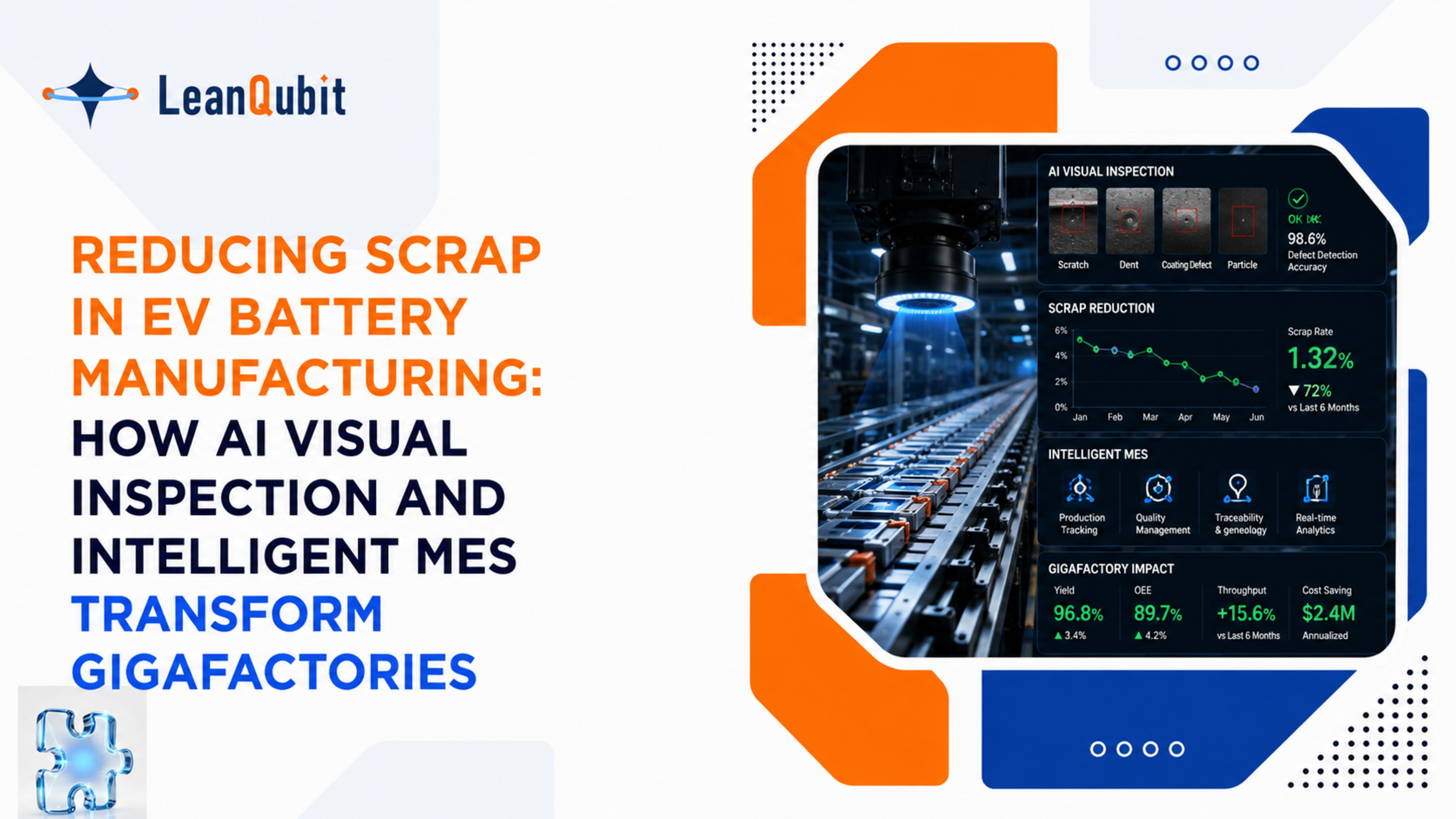
- High scrap rates in electrode coating and cell assembly remain the biggest threats to gigafactory profitability and scalable production.
- AI-driven visual inspection (FactoVision) catches micro-defects at the coating and calendaring stages before value is added to defective materials.
- Integrating AI with a modern manufacturing execution system (FactoMES) provides the end-to-end traceability required for stringent battery cell compliance.
- Autonomous industrial agents (FactoIQ) move operations beyond basic dashboards, correlating quality drops with upstream process deviations for instant root-cause analysis.
- Connecting legacy PLCs and modern AI without rip-and-replace allows battery plants to rapidly deploy operational intelligence with zero hardware disruption.
The Yield Challenge in Modern Gigafactories
The global transition to electric vehicles (EVs) hinges on the manufacturing efficiency of gigafactories. While capital is pouring into new facility construction and high-speed production equipment, operations leaders face a persistent and costly hurdle: yield optimization. In the early stages of a gigafactory’s ramp-up, scrap rates can hover between 15% and 30%. Even mature battery production lines fight daily battles to maintain scrap rates below 5%.
In battery manufacturing, every percentage point of scrap represents millions of dollars in wasted active materials—lithium, nickel, cobalt, and graphite—alongside massive energy consumption. Plant managers and quality engineers are under immense pressure to increase throughput without compromising the strict safety and performance tolerances required by automotive OEMs. To achieve this, manufacturers must eliminate operational blind spots and transition from reactive quality control to proactive, AI-driven process orchestration.
The Hidden Costs of Late-Stage Defect Detection
Battery manufacturing is a complex blend of continuous chemical processing and discrete mechanical assembly. The value chain typically flows from slurry mixing and electrode coating to calendering, slitting, cell assembly (winding or stacking), electrolyte filling, and finally, formation and aging.
The electrode coating process is arguably the most critical step for determining final cell quality. If a defect—such as an uneven coating thickness, a pinhole, an agglomerate, or a blister—occurs here but goes undetected, the defective foil continues down the line. It is calendered, slit, wound into a jelly roll, welded, and filled with expensive electrolyte.
If the defect is only caught during end-of-line testing (such as a short circuit detected during formation), the financial impact is magnified exponentially. The manufacturer has not only wasted the initial raw materials but also the downstream processing time, energy, and additional components. Catching defects at the point of origin is the only way to protect gigafactory margins.
Catching Micro-Defects Early with AI Visual Inspection
Traditional machine vision systems have long been used in manufacturing, but they struggle in the battery plant environment. Conventional vision relies on rigid, rule-based algorithms. When applied to the highly reflective, dynamic surfaces of coated copper or aluminum foils, these systems frequently generate false positives or miss subtle anomalies due to slight changes in factory lighting or material variance.
This is where AI-powered visual inspection fundamentally changes the game. Solutions like LeanQubit’s FactoVision utilize deep learning and computer vision to understand what a “good” surface looks like organically. Rather than relying on hardcoded rules, AI models are trained on extensive datasets of both nominal production and known defects.
FactoVision can instantly identify complex, irregular anomalies on the coating line—such as micro-bubbles, solvent drip marks, subtle scratches, and foil exposure—with extreme precision. By deploying high-resolution camera data analyzed at the edge, plant teams can flag and isolate defective electrode patches in real time, preventing them from ever reaching the slitting and cell assembly stages.
Pro Tip: The Importance of Edge Detection in Coating
Precise edge detection during the continuous coating process is critical. Minor deviations or undulations in the uncoated margin (the “clear lane”) can lead to catastrophic short circuits during the winding phase. AI vision models dynamically adjust to environmental variations, ensuring millimeter-accurate edge measurement without the need for constant manual recalibration by operators.
Disconnected Data: The Enemy of Battery Traceability
Detecting a defect is only half the battle; knowing exactly why it happened and logging it against the product genealogy is the other. EV manufacturers face stringent regulatory and OEM requirements for complete, cell-level traceability. If a thermal runaway event occurs in the field three years later, the manufacturer must be able to trace that specific battery cell back to its exact slurry batch, coating parameters, and operator shift.
The barrier to this traceability is disconnected operational data. In many plants, the slurry mixer’s PLC doesn’t communicate with the coating line’s SCADA, which in turn is isolated from the quality inspection cameras and the enterprise ERP. Operations teams are left with delayed decisions, risky OT-IT exposure, and no foundation for AI.
LeanQubit solves this by delivering standard-based industrial connectivity. We connect PLCs, CNCs, sensors, SCADA, and MES environments into a secure real-time architecture. By utilizing edge gateways to translate mixed protocols (OPC UA, MQTT, Modbus) into a unified stream, manufacturers can connect every relevant asset without forcing a “rip-and-replace” of their existing legacy machines.
Tying It Together with an AI-Ready MES
Once shop floor data is unified in an operational data foundation (like FactoLake), it requires manufacturing context. This is the domain of a modern Manufacturing Execution System. However, standard MES platforms are often too rigid and database-heavy to handle the high-velocity, high-volume time-series data generated by gigafactories.
FactoMES is architecturally designed to serve as the data foundation for AI. It seamlessly binds machine telemetry and quality events to production lines, work orders, and plant-floor workflows. As a result, FactoMES delivers end-to-end genealogy, linking raw material intake to the final cell assembly, ensuring compliance and providing the rich contextual data necessary for machine learning models to thrive.
Orchestrating Quality with Autonomous AI Agents
Dashboards and alarms are no longer sufficient. When operators are bombarded with generic alerts, the result is alarm fatigue, delayed root-cause analysis, and operational decisions that conflict across domains. The goal of a smart gigafactory is not to just monitor data, but to orchestrate action.
LeanQubit’s FactoIQ deploys specialized, deterministic AI agents directly into your shop floor infrastructure to proactively optimize production:
- QualIQ (Quality Root Cause Analysis): If FactoVision detects a sudden spike in coating pinholes, QualIQ immediately correlates this defect with upstream process variables. It might identify that a slight drop in the drying oven temperature or a deviation in slurry viscosity is the root cause, delivering a confident recommendation to the quality lead rather than requiring hours of manual data mining.
- MaintIQ (Predictive Maintenance): The heavy rollers in a calendering press wear down over time, directly impacting electrode density. MaintIQ continuously analyzes vibration and torque data to predict roller failure or degradation, allowing maintenance teams to schedule interventions before a quality deviation occurs.
- ProdIQ (Throughput Optimization): Battery plants must balance high-speed continuous processes with intricate discrete assembly. ProdIQ analyzes execution data to surface line bottlenecks, optimizing schedules to prevent starved winding stations or overflowing buffer buffers.
Implementing Intelligence Without Halting Production
For plant heads and OT leaders, the thought of deploying AI often brings fears of massive IT projects and prolonged downtime. LeanQubit’s framework is built for practical, phased industrial deployment. The process begins with a connectivity audit to map assets, data flows, and security constraints. From there, teams can pilot integration in a single production area—such as the coating line—establish live data transport, and validate signal quality.
Because LeanQubit bridges legacy hardware with AI-native software, operations teams get one usable stream of plant data instead of isolated pockets, scaling intelligence line by line, plant by plant.
Conclusion
Scaling a gigafactory requires more than just aggressive capital investment and faster machinery; it demands continuous, closed-loop intelligence. By integrating AI-driven visual inspection with a modern, connected MES, battery manufacturers can catch micro-defects at the source, ensure absolute traceability, and empower their teams with proactive root-cause analysis. Bridging legacy hardware with AI-native software is the most effective path to eliminating blind spots, slashing scrap rates, and confidently meeting the surging global demand for electric vehicles.
Frequently Asked Questions
Traditional vision systems use fixed geometric rules that struggle with the highly reflective, dynamic surfaces of battery foils, often resulting in high false-rejection rates. AI visual inspection (like FactoVision) uses computer vision models trained on extensive, varied defect datasets. This allows the system to adapt to lighting changes and accurately identify complex, irregular anomalies—such as micro-bubbles, agglomerates, or subtle scratches—with superior accuracy.
No. A core philosophy of the LeanQubit architecture is zero hardware replacement. We utilize secure edge buffering and forwarding gateways to translate mixed protocols (such as OPC UA, Modbus, and legacy proprietary protocols) from your existing Siemens, Rockwell, or legacy PLC estates into a unified operational data stream.
Battery manufacturing generates gigabytes of time-series, event, and high-resolution image data daily. FactoMES is built in tandem with FactoLake, our centralized operational data foundation. This architecture decouples high-speed machine data buffering from transactional MES logic, allowing the platform to ingest massive data volumes and scale from a single pilot line to a global network of plants without latency.
FactoIQ agents are designed to deliver highly confident, deterministic recommendations tied to specific plant contexts. While they continuously analyze and interpret conditions autonomously, they are typically configured to escalate actionable recommendations to plant personnel (like maintenance or quality leads) for approval, ensuring humans remain in the loop for critical operational changes.
Stop letting disconnected systems hide the root causes of your production losses. Ready to deploy AI-driven visual inspection and intelligent manufacturing execution across your battery lines?
Explore LeanQubit FactoVision and FactoMES today, or contact our team to schedule a plant connectivity audit.