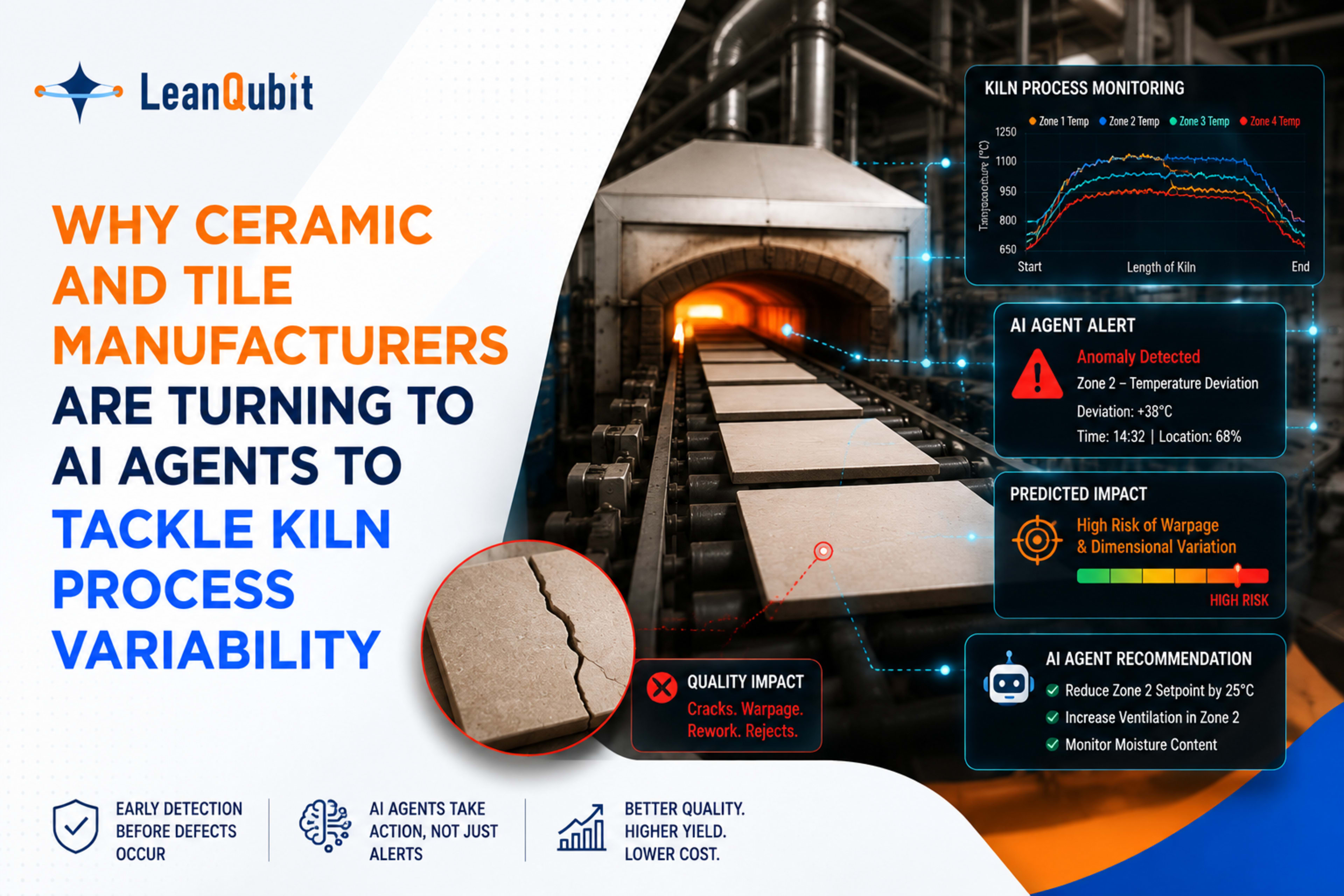
- Kiln process variability is one of the highest-impact — and least-digitized — quality drivers in ceramic and tile manufacturing. Defects discovered after firing cannot be reworked.
- AI process agents like ProcIQ detect firing curve deviations as they develop, enabling operators to act before product is compromised — not after the batch has cooled and been sorted.
- Connecting in-kiln process data to post-kiln quality outcomes enables root-cause analysis that most ceramic plants still perform manually, or not at all.
- The data architecture matters as much as the AI model: kiln sensor data, recipe parameters, and quality inspection results must be unified in a single platform before meaningful pattern recognition becomes possible.
Ceramic tile and sanitaryware plants spend enormous effort on raw material consistency, press parameter optimization, and glaze application precision — and then everything passes through the kiln. The roller kiln is where product is made or unmade, and it is unforgiving by nature. Defects caused by temperature non-uniformity, an incorrect firing curve, or an unexpected shift in kiln atmosphere cannot be reversed once the product has cooled and exited the kiln. By the time a quality inspector marks a tile as warped, oversized, or discolored, the entire batch fired alongside it is already committed.
This structural problem is one that reactive quality control cannot solve. And it explains why ceramic and tile manufacturers are increasingly looking at AI-driven process intelligence — not as a digital transformation aspiration, but as a practical answer to a yield and waste problem that has resisted conventional approaches.
The Kiln Firing Problem Is a Data Problem in Disguise
Modern roller kilns run firing cycles that last anywhere from 40 minutes for fast-fire porcelain tile to several hours for thicker technical ceramics. Across that cycle, dozens of thermocouples, burner control valves, and atmosphere sensors generate continuous data streams — most of which flows into a SCADA historian and is reviewed only when something visibly goes wrong.
Kiln process drift is often subtle at first. A burner in zone 4 gradually loses combustion efficiency. A thermocouple reading drifts 8°C above its calibrated value. The atmosphere in the oxidation zone shifts slightly toward reduction. None of these anomalies triggers an immediate alarm, but each one moves the firing curve away from the recipe specification for the product currently in the kiln — and by the time downstream quality results reveal the impact, the batch is already fired and cooled.
The data to detect these deviations early exists in the kiln itself. The analytical layer to act on it typically does not.
Why Operator Experience Is Not a Scalable Answer
Experienced kiln operators develop an intuitive feel for their equipment — recognizing early signs of process drift from a specific combination of zone temperatures, draft pressure, and product-specific historical knowledge. This expertise is genuinely valuable.
The problem is familiar across manufacturing industries: this knowledge is not systematically documented, not reliably transferred across shift changes, and not available at 3 AM when a newer operator is watching an unfamiliar product profile run. A plant operating three roller kilns simultaneously may have three different operational fingerprints, making cross-kiln consistency difficult to achieve even with experienced staff.
This is the “loss of tribal knowledge” challenge that surfaces repeatedly across process manufacturing — and in ceramic and tile production, it is amplified by the irreversibility of the kiln firing step. When the knowledge gap matters most, there is no ability to course-correct after the fact.
In ceramic tile production, warpage is one of the most common quality defects — and it is almost entirely a kiln process outcome. Temperature differentials as small as 10–15°C between the upper and lower surfaces of the kiln channel, or between zones on either side of the kiln width, are sufficient to cause measurable warpage in large-format tiles. These differentials develop gradually and are rarely visible from a single-zone temperature reading alone.
Where AI Process Agents Change the Calculation
An AI process agent like ProcIQ does not replace kiln operators. It does something more specific: it monitors the full envelope of kiln process data in real time, learns what normal operation looks like for each product recipe, and flags deviations early enough for operators to act before quality is affected.
In practical terms, this means:
- Continuous comparison of the live firing curve against the active recipe specification, with zone-level granularity.
- Early anomaly detection when a burner, thermocouple, or atmospheric parameter begins drifting outside normal operating bounds — not only when it crosses a hard alarm threshold
- Recommended corrective actions generated from historical operational data, giving operators a clear starting point rather than leaving them to diagnose from scratch
- Shift-to-shift pattern analysis that surfaces recurring deviations tied to specific product codes, kiln zones, or time-of-day patterns
This is the difference between a system that records that a problem occurred and one that helps prevent it. For kiln-fired ceramic products, that distinction translates directly into first-quality yield, energy cost per square metre produced, and rejection and rework rates.
Recipe Management at Scale Introduces Hidden Complexity
A mid-sized ceramic tile plant producing multiple formats, finishes, and body types may run dozens of distinct firing recipes across its kilns. Each recipe specifies zone temperatures, cycle time, peak temperature, cooling curve, and atmospheric parameters — and each product behaves differently under nominally identical conditions depending on body composition, pressing moisture content, and glaze chemistry.
Managing this complexity without a structured digital framework creates a risk that is easy to underestimate: the wrong recipe being loaded for a production run, or the correct recipe being used without understanding its historical drift patterns. When a new tile format or glaze combination enters production, operators typically rely on empirical adjustment — running trial loads, observing results, and modifying parameters — without a systematic record of what worked and why.
FactoMES addresses the execution layer of this problem by ensuring the correct recipe is verified before each firing cycle begins, with traceability linked to the specific production batch. FactoLake stores the full parameter history for every recipe run — actual firing profiles, not just nominal setpoints — so that FactoIQ can identify which parameter combinations correlate with first-quality outcomes versus those that consistently produce dimensional or surface variation. Over time, this builds a data-driven recipe optimization capability that is not achievable when recipe knowledge resides in binders, spreadsheets, or operator memory.
Connecting Kiln Data to Quality Outcomes Closes the Loop
The quality inspection step in ceramic tile manufacturing — whether manual grading, automated dimensioning, or AI vision inspection — generates data that in most plants is completely disconnected from the process data that produced the quality result. A tile is graded third-quality due to warpage. But which kiln zone produced the temperature differential responsible? Which shift was running? Is the issue specific to this glaze type or consistent across body compositions?
QualIQ, LeanQubit’s quality AI agent, connects quality outcomes to upstream process conditions by analyzing the full data environment when a quality event occurs. When post-kiln inspection data is unified with kiln sensor data in FactoLake, root-cause analysis moves from a manual investigation triggered by a customer complaint to an ongoing analytical function that operates continuously in the background.
For ceramic and tile manufacturers, this closed-loop quality intelligence also changes the economics of new product introduction. The learning curve for optimizing a new tile recipe compresses significantly when historical data from analogous products can be systematically analyzed rather than reconstructed from memory.
Automated Surface Inspection at Post-Kiln Sorting
Surface quality inspection in tile manufacturing — checking for glaze crawling, pinholes, color deviation, dimensional accuracy, and edge chips — is traditionally performed by human graders working at line speed. This approach is inherently inconsistent: graders tire over a shift, inspection criteria are interpreted differently across teams, and subtle surface anomalies are easy to miss under production-rate time pressure.
FactoVision brings automated AI visual inspection to the post-kiln sorting line, enabling consistent defect detection across all tiles at production speed. It evaluates size, shape, and surface appearance against defined quality standards, triggers in-line reject decisions, and feeds defect classification data back into the broader quality analytics framework. When a pattern emerges — glazing anomalies concentrated in tiles from a specific kiln zone or firing time window, for instance — it becomes visible in the analytics rather than buried in sorting records.
Predictive Maintenance on Kiln Assets
Roller kilns are mechanically demanding environments. Rollers, drive systems, burners, and refractory linings all degrade over time — and in a high-temperature environment, degradation can accelerate unpredictably. An unplanned kiln shutdown during a production run results in all product currently inside being scrapped, plus the production lost during cooldown and restart.
MaintIQ monitors the health of kiln components using the same sensor data streams that control the kiln — vibration signatures from roller drives, temperature asymmetries that suggest refractory damage, and burner combustion efficiency trends indicating fouling or valve wear. Rather than scheduling maintenance on fixed intervals, it flags components showing early degradation signals for intervention during planned maintenance windows, before a breakdown occurs. For plants running kilns continuously, the cost difference between a planned roller change during a scheduled stop and an unplanned mid-cycle failure is substantial — in both direct repair cost and in the product loss from the interrupted firing run.
Conclusion
Ceramic and tile manufacturing runs on process precision, and the kiln is the point in the process where precision matters most and visibility has historically been lowest. AI agents and connected manufacturing intelligence do not change the physics of sintering — but they do change the information environment that operators, quality engineers, and plant managers work within, shifting from reactive interpretation of after-the-fact data toward proactive intervention while there is still time to act.
For plants that have accepted kiln variability as an unavoidable cost of production, connected intelligence offers a different perspective: most of the data needed to catch deviations early already exists in the kiln and on the quality line. The gap is not in sensors — it is in the analytical layer that turns that data into decisions.
Frequently Asked Questions
SCADA captures and displays kiln data; a process AI agent actively analyzes it. The difference is in the depth and type of pattern recognition. A SCADA alarm fires when a parameter crosses a fixed threshold. ProcIQ detects the directional drift toward that threshold — and correlates it with product recipe and historical quality outcomes — before the alarm condition is reached. SCADA provides the data source; the AI agent provides the intelligence layer on top of it.
The minimum viable starting point is kiln zone temperature data, product recipe assignments per run, and a quality output — even if that output is manual grade records from sorting. Additional data sources such as atmospheric sensors, pressing parameters, glaze line data, and raw material moisture readings improve analytical accuracy over time but are not prerequisites for a first deployment.
Yes — this is one of the most practical multi-asset applications. When the same product recipe runs on multiple kilns, ProcIQ can identify which kilns achieve the best first-quality yield for specific product types, what parameter differences drive that outcome, and how to bring underperforming kilns closer to the best-kiln benchmark. This kind of cross-kiln analysis is very difficult to do systematically without a unified data platform.
FactoMES manages execution: the correct recipe is assigned to each production batch, confirmed before firing begins, and tracked through the kiln cycle. FactoLake stores both the nominal recipe parameters and the actual process data recorded during every run. FactoIQ then analyzes both layers to identify where actual firing profiles deviated from specification and how those deviations correlated with the quality outcomes recorded post-kiln.
Evaluate where connected intelligence can close the gaps in your ceramic or tile production process. Discover how LeanQubit’s solutions can reduce kiln-related defects and improve quality on your production line.