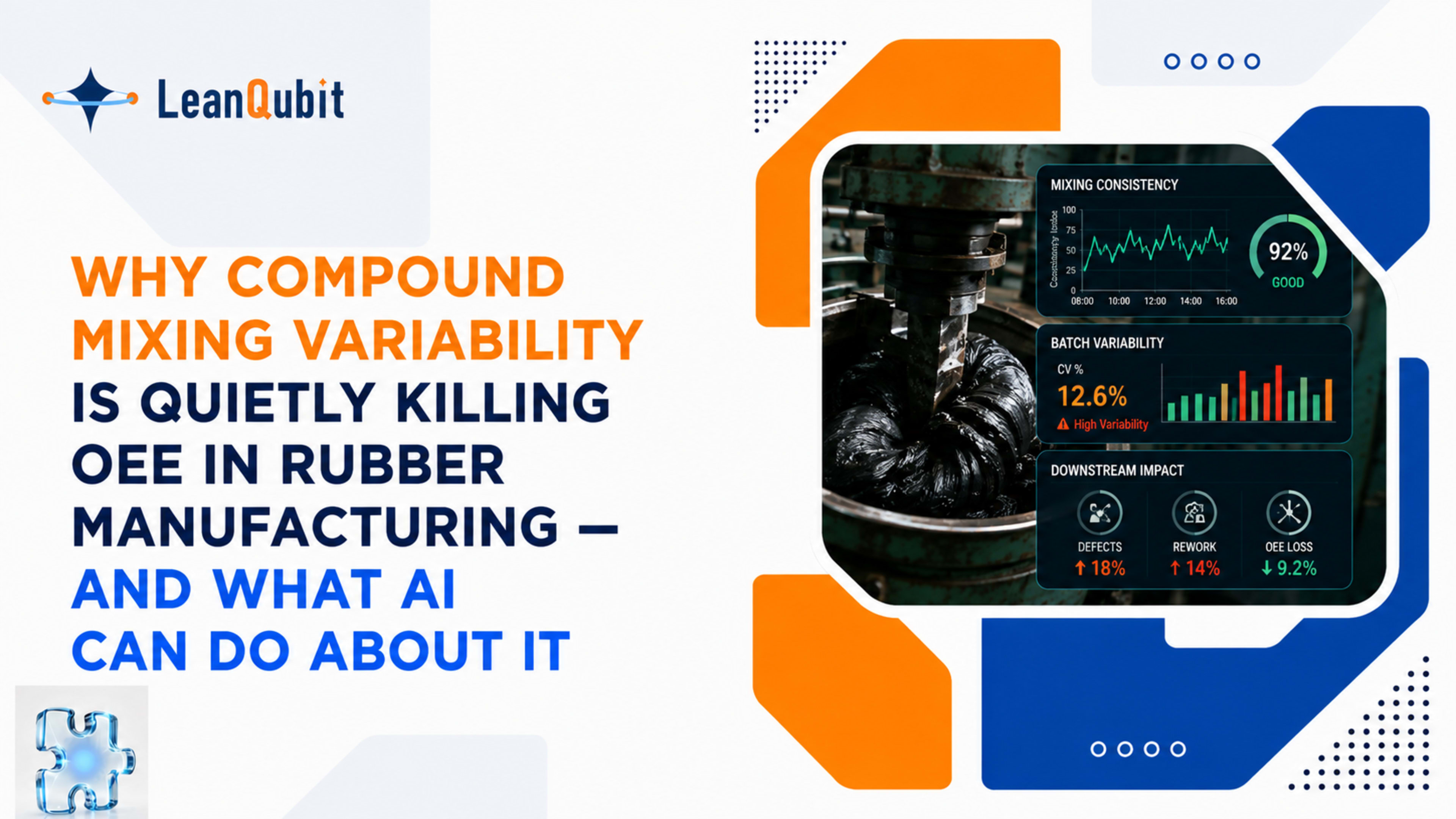
- Compound mixing variability is one of the most underreported root causes of downstream defects, scrap, and production efficiency loss in rubber manufacturing.
- Traditional end-of-line quality checks are too late — by the time a defect is caught, the cost has already compounded across multiple production stages.
- Real-time OT data integration from mixing equipment enables continuous process monitoring that catches deviation before it reaches molding or curing.
- AI-driven process agents can identify the specific parameter combinations — temperature, rotor speed, dump time, energy input — that produce off-spec compound batches.
- Manufacturers that connect mixing intelligence to downstream process data see measurable improvement in OEE, first-pass yield, and material efficiency.
Rubber manufacturing operates on a quiet paradox. The most consequential production decision in the entire workflow — whether a compound batch is truly on-spec — is also the hardest to verify in real time. Unlike metal machining or electronics assembly, rubber compounding involves complex thermochemical interactions that no visual inspection or post-mix test can fully characterize before the material moves downstream.
The result is a chronic, largely invisible OEE problem hiding inside mixing rooms across rubber product plants worldwide. This article explores why compound mixing variability is so damaging, how it cascades through the production system, and what a connected, AI-enabled approach to process monitoring is doing to change that picture.
The Compounding Problem That Rarely Gets Named
In most rubber manufacturing operations — whether producing industrial hoses, automotive seals, conveyor belts, vibration isolators, or molded components — the compounding stage is where the quality trajectory of every downstream product is set. Banbury mixers, internal mixers, and open mill systems blend base polymers with fillers, plasticizers, curatives, and accelerators under precisely timed and temperature-controlled conditions.
The challenge is that the physical and chemical behavior of a rubber compound is highly sensitive to small deviations. Consider what each of the following can mean for downstream quality:
- Dump temperature rising even 5–10°C above specification can alter cure rate meaningfully, causing inconsistent crosslink density in the finished part.
- Rotor speed variations during dispersion affect filler distribution, which directly influences mechanical properties such as tensile strength and elongation at break.
- Moisture in incoming raw materials — even within accepted incoming tolerance — can shift compound viscosity enough to cause cure inconsistency in the press.
- Sequential batch drift, where each individual batch looks acceptable but a gradual shift accumulates across multiple cycles, goes undetected until downstream defect rates spike.
In many rubber plants, the response to these issues is manual: operators rely on Mooney viscosity readings taken after mixing, visual checks of mill sheet appearance, and experience-based adjustments. These are valuable inputs, but they are reactive, intermittent, and deeply dependent on individual operator knowledge — exactly the kind of tribal knowledge that is difficult to retain, scale, or act on quickly across a multi-shift production environment.
How Variability Compounds Downstream
The most damaging aspect of compound mixing variability is that its consequences are rarely felt at the mixing stage itself. By the time the problem surfaces — as a cure anomaly in a press, an adhesion failure in a bonded assembly, or a dimensional rejection in a molded part — the mixing event that caused it may have occurred hours or even an entire shift earlier.
This disconnect breaks the feedback loop that process engineers depend on. Without real-time data connecting mixing parameters to downstream outcomes, every quality investigation becomes a detective exercise pieced together from incomplete records, operator memory, and batch logbooks.
The downstream cost multiplication is real and significant. Consider the chain reaction that a single off-spec compound batch can trigger:
- Off-spec compound that reaches molding produces scrap or requires rework, consuming press time, labor, and energy with zero output value.
- Curing presses running material with inconsistent cure systems experience elevated cycle-time variability, increasing the risk of undercure or overcure across a production run.
- In high-compliance supply chains — automotive, industrial safety, medical components — traceability failure, specifically not knowing with certainty which compound lot was used in which finished parts — can trigger containment actions that are far more expensive than the original defect.
OEE degrades at every stage. Availability is affected by unplanned press downtime. Performance is affected by cycle-time inconsistency. Quality is affected by elevated defect and rework rates. And because these losses are distributed across multiple cost centers, the true financial impact of mixing variability is almost always underreported at the plant level.
What Real-Time Process Monitoring Changes
The first meaningful shift toward breaking this cycle is connecting OT data from mixing equipment into a unified real-time monitoring environment. This means capturing and contextualizing actual machine data continuously — not as periodic manual entries in a logbook, but as live process signals tied to each batch and each production event. The parameters that matter most in a rubber compounding environment typically include:
- Batch-level mixing parameters: energy input curve, rotor speed profile, compound temperature over time, dump temperature, total mix time
- Raw material lot identifiers and incoming quality parameters linked to each batch
- Operator interventions and manual additions recorded by timestamp
- Environmental conditions in the mixing area, particularly ambient temperature and relative humidity, which can affect compound behavior.
When this data is captured continuously and made available in a centralized system, it becomes possible to build a dynamic picture of process health across every batch, every shift, and every compound family. Deviations from the established process envelope become visible immediately — not as an investigation finding the following morning, but as a real-time alert that allows operators and engineers to respond before off-spec material travels further down the line.
More importantly, this connected data layer enables genuine correlation analysis. When a press run shows elevated scrap rates, engineers can trace back to the specific compound batches used, examine the complete mixing parameter record for that production window, and identify the actual combination of factors — a temperature deviation, an extended mix cycle, an atypical energy curve — that produced the off-spec result. That kind of traceability transforms reactive quality management into a structured, data-driven improvement process.
Where AI Process Intelligence Adds a Different Level of Capability
Real-time monitoring surfaces the signal. AI process intelligence extracts actionable meaning from it at a speed and scale that manual analysis cannot match — and it does this continuously, across every batch, without fatigue or variation in attention.
In a connected rubber manufacturing environment, AI-driven process agents applied to compounding operations can deliver capabilities that go well beyond dashboard monitoring:
Early Warning Before Material Moves
Rather than waiting for a post-mix Mooney viscosity result or a press-side quality check, an AI process agent can recognize parameter patterns from the current mixing cycle that historically correlated with off-spec compound in this facility. A warning generated before the material reaches the mill or the warehouse stage is worth far more than a rejection at the finished goods stage.
Batch Trend Detection Across Shifts
Individual batches may each fall within specification limits while a gradual process drift develops across a shift or a production run. Batch-to-batch parameter trends reveal this systematic deviation before it produces a quality failure. Human operators monitoring shift-by-shift averages frequently miss this kind of slow drift; AI process monitoring catches it because it is evaluating every batch in the context of the full historical baseline.
Process Correction Recommendations
When deviations are detected, the system can suggest specific corrective actions grounded in this plant’s own historical process data — adjusted dump temperature targets, modified mixing cycle time, alternative raw material lot selection — rather than generic guidance that may not reflect the specific compound formulations or equipment behaviour in this facility.
Recipe Adherence and Automatic Traceability
In plants running multiple compound formulations across shared mixing equipment, connected process intelligence can enforce recipe parameter adherence, flag unauthorized substitutions or out-of-sequence additions, and automatically document actual process conditions against intended parameters for each batch. This creates a reliable traceability record without the burden of manual data entry — and without the errors that manual record-keeping inevitably introduces across multiple shifts.
Building the Connected Rubber Manufacturing Environment
The path to AI-driven process intelligence in rubber manufacturing is not a single technology decision. It requires assembling a connected production environment where data flows from equipment to analytics without gaps, silos, or manual hand-offs. In practice, that typically means addressing four interconnected layers:
OT Connectivity from Mixing Equipment
Mixing machines, mills, calendering lines, and presses need to be connected in a way that enables continuous, real-time data capture. Rubber plant floors often present a challenging mix of older PLCs running legacy protocols such as Modbus alongside newer machines with OPC-UA interfaces. IoT gateways and edge devices capable of bridging this diversity are a prerequisite for a unified data environment.
Centralized Industrial Data Management
High-volume rubber compounding operations can generate substantial process data across multiple shifts, product families, and equipment groups. A centralized industrial data platform — organized and governed for both real-time monitoring and historical analysis — provides the foundation that makes both alert-based monitoring and AI model training possible.
AI Models Trained on Plant-Specific Data
Rubber compound behaviour is highly formulation-specific and equipment-specific. A cure profile that signals a problem in one compound family may be perfectly normal in another. Effective process AI for rubber manufacturing is built on the plant’s own historical data — batch records, quality outcomes, process parameters — and requires a sufficient base of labeled, structured data before reliable prediction and recommendation is possible.
Operator-Facing Dashboards and Alert Systems
The role of AI in rubber process optimization is to augment human decision-making, not to replace it. The most effective implementations surface insights and recommendations through clear, actionable operator interfaces that keep the right people informed at the right moment — without overwhelming them with data that requires interpretation expertise they may not have in the middle of a production shift.
Before pursuing AI-based process optimization in a compounding environment, audit your current data capture completeness at the mixer level. Many plants discover that consistent batch-level data — dump temperature, specific energy, cycle time — is not being recorded systematically, which is the foundational gap to close first.
The Business Case Is Clearer Than It Looks
Manufacturers evaluating process intelligence investments in compounding often underestimate the true cost of mixing variability because its consequences are distributed across multiple cost categories: raw material scrap, rework labor, press downtime, containment investigation time, and quality system overhead. When these are aggregated and traced back to their root cause at the mixing stage, the financial case for real-time process monitoring is frequently more compelling than initial estimates suggest.
The efficiency impact generally shows up across three measurable dimensions:
- Quality yield improvement: First-pass yield rates increase when off-spec material is identified and held at the mixing stage rather than being discovered at the finished goods stage, preventing the cost multiplication of processing defective compound through press cycles.
- Scrap and rework reduction: Catching compound deviation early — before the material enters a press or autoclave — prevents the energy, labor, and machine time consumed by processing material that will ultimately be rejected or require rework.
- Equipment efficiency and maintenance: Continuous monitoring of mixer energy consumption curves, bearing temperature trends, and cycle-time profiles enables condition-based maintenance scheduling that reduces unplanned downtime on compounding equipment, which is typically a throughput constraint for downstream production lines.
The cumulative effect on OEE across a rubber manufacturing operation can be significant, particularly where mixing is the pacemaker for downstream production capacity.
Conclusion
Compound mixing variability has been a chronic, accepted cost in rubber manufacturing for a long time — accepted not because it is unavoidable, but because the tools to detect and correct it in real time have not been practically accessible at the plant floor level. That is changing.
The combination of connected OT data, centralized industrial data platforms, and AI-driven process intelligence is making it possible to monitor, understand, and improve the compounding stage in ways that were not feasible with traditional quality control approaches. The result is a manufacturing environment where defects are caught at their source, process knowledge is captured and scaled rather than locked in individual operator experience, and OEE improvement is driven by intelligence rather than by reaction.
For rubber manufacturers competing in markets where product quality, supply reliability, and cost efficiency are simultaneously under pressure, building this connected intelligence layer at the compounding stage is one of the highest-return investments available in the current phase of industrial digital transformation.
Frequently Asked Questions
Connectivity complexity varies depending on the age and type of equipment. Most modern rubber mixing machines, even those more than a decade old, have PLCs that can expose process data through standard industrial protocols such as Modbus or OPC-UA. Where direct PLC connectivity is not practical, edge computing devices can be deployed to aggregate available signals. A connectivity assessment — inventorying the equipment types, existing control systems, and available data outputs — is the practical first step before specifying an integration approach.
The value of real-time monitoring scales with production volume and product complexity, but it is not exclusive to large operations. Mid-size rubber manufacturers serving automotive, industrial, or safety-critical markets often have the most to gain from connected process intelligence, because the consequences of quality escapes in these supply chains are disproportionately large relative to the scale of the plant. The right implementation approach is modular — starting with the mixing stage and the highest-value compound families — rather than requiring a plant-wide transformation at once.
This distinction depends on recipe and change management integration. In a connected manufacturing environment where production orders, compound formulations, and approved recipe parameters are managed digitally, the process monitoring system can compare real-time parameters against the specific approved envelope for the current production order. An intentional recipe change approved through the change management process updates the reference parameters. An unplanned deviation from the active recipe — such as an unexpected dump temperature or extended cycle time — is flagged as an anomaly regardless of whether it looks acceptable in absolute terms.
Not entirely, and that is not the right framing for how these capabilities relate to each other. Laboratory testing such as Mooney viscosity, rheometer cure curves, and physical property testing remains important for process validation, new compound development, and regulatory or customer documentation requirements. Real-time process monitoring complements these laboratory checks by providing continuous coverage between test points — catching deviations in the mixing process that may not be apparent in a single post-mix sample — and by enabling faster identification of which batches warrant priority lab review when a mixing anomaly is detected.
At minimum, you need consistent batch-level records of the key mixing parameters — dump temperature, specific energy, rotor speed profile, and cycle time — linked to corresponding quality outcomes such as Mooney viscosity results, press-side cure data, and finished part quality disposition. The data does not need to be complete from day one, but it needs to be structured, consistently captured, and traceable to individual batches. In many plants, the initial phase of a process intelligence project is focused on establishing this data foundation before AI model development begins.
Is compound variability affecting your production efficiency and quality outcomes? Explore how LeanQubit’s connected manufacturing intelligence platform can help your rubber manufacturing operation build real-time visibility and AI-driven process control from the mixing stage through to finished goods. Visit leanqubit.ai to learn more or connect with our team to discuss your specific manufacturing challenges.