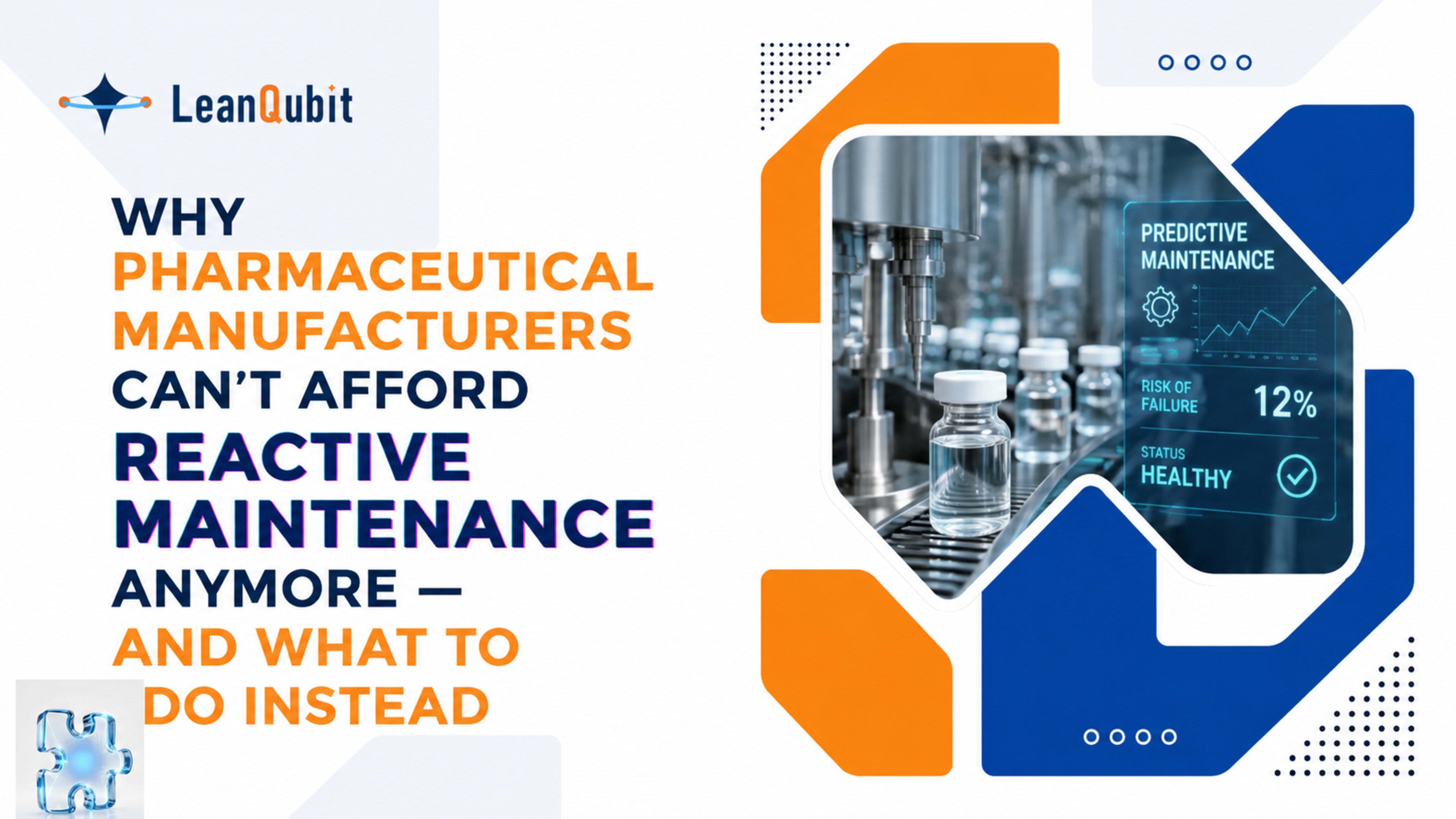
- Reactive maintenance in pharmaceutical manufacturing carries costs that go far beyond lost uptime — a single unplanned equipment failure can invalidate an in-progress batch, trigger a regulatory investigation, and set back production schedules by days or weeks.
- The shift from reactive to predictive maintenance in pharma is fundamentally a data problem: most plants already generate the signals needed to detect failure patterns early, but those signals live in disconnected systems and never reach the people responsible for maintenance decisions.
- Predictive maintenance in a regulated manufacturing environment requires more than good sensor data — it requires that the data, the prediction, and the resulting action are all traceable and audit-ready, which is why the underlying data architecture matters as much as the AI model itself.
- Domain-specific AI agents — focused exclusively on maintenance reasoning — outperform generalist monitoring dashboards in pharma environments because they interpret equipment signals in the context of that specific machine's history, operating conditions, and prior failure patterns.
- The practical starting point is not a full-plant deployment. One production line, one class of equipment, one domain — validated against measurable outcomes — is the path that builds confidence with both operations and compliance teams before scaling.
The maintenance problem in pharmaceutical manufacturing is different from other industries
Every manufacturer loses money to unplanned downtime. In most industries, an unexpected equipment failure means lost production time, a rush to source a part, and an unscheduled stop while a technician works through the fix. Expensive, disruptive — but usually recoverable.
In pharmaceutical manufacturing, the consequences don’t stop there.
A filling line that stops mid-batch, a granulator that drifts out of specification, a lyophilizer that fails during a freeze-dry cycle — these aren’t just mechanical failures. They’re potential batch invalidations. And a batch invalidation in pharma means scrapped materials, failed product release, and potentially a root-cause investigation that touches the quality management system, the batch record, and in some cases, the regulatory authority overseeing the facility.
This is why the decision to continue running maintenance programs reactively — waiting for something to fail before addressing it — carries a fundamentally different risk profile in pharmaceutical operations than it does in most other manufacturing environments. The cost of a breakdown isn’t just the downtime. It’s what the downtime contaminates.
The real cost of reactive maintenance in pharma:
A granulator failure that stops a batch at 60% completion doesn’t just cost one production run — it triggers a deviation report, a CAPA investigation, and a root-cause analysis that pulls quality engineering time for days. The direct production loss is often the smallest item on that list.
Why reactive maintenance persists — even in facilities that know better
Most pharmaceutical operations teams already understand, in principle, that predictive maintenance would be better than reactive. The question that comes up in practice is: why hasn’t it happened already?
The honest answer is usually one of three things — and often all three at once.
The data exists, but it doesn’t connect:
A modern pharmaceutical manufacturing facility generates enormous volumes of equipment data — vibration readings from critical rotating equipment, temperature and pressure readings from process vessels, runtime data from motors and pumps, alarm histories from SCADA systems. The signals that would allow an early warning of failure are almost always being collected somewhere.
What isn’t happening is that those signals are reaching the right people in time to act on them. Data lives in the historian. Maintenance decisions live in the CMMS. Production records live in the MES. Quality records live in a quality management system. Each of these systems holds a piece of the picture, but none of them is connected in a way that lets anyone see the whole thing.
Preventive maintenance schedules don’t reflect actual equipment condition
Most pharmaceutical facilities run time-based or cycle-based preventive maintenance programs — change the seal every 2,000 hours, inspect the bearing every quarter, replace the filter on a fixed schedule. These schedules were built from manufacturer recommendations and historical failure data, and they’re not wrong exactly — but they’re also not optimised.
A pump that runs under light load in controlled conditions may be perfectly serviceable at 3,000 hours. A pump running in a more demanding process environment may need attention at 1,200 hours. A calendar-based schedule treats both the same way, which means some maintenance happens too early (wasting resource and creating unnecessary intervention risk) and some happens too late (missing the failure window).
Maintenance teams are already stretched, and more alerts create noise — not insight
The response from many facilities to the data visibility problem has been to add monitoring tools that generate more alerts. And while the intention is good, the result is frequently alert fatigue: a maintenance engineer who receives 200 condition alerts per day quickly learns to filter most of them. When the genuinely important signal arrives, it’s competing with everything else.
More data displayed on a dashboard doesn’t solve the problem. Interpreted data — a recommendation, with context, surfaced at the right moment — is what changes behaviour.
What predictive maintenance actually looks like in a pharmaceutical plant
The term “Predictive Maintenance” gets used to describe everything from time-series anomaly detection to vibration analysis to AI-powered failure prediction — which makes it hard to have a precise conversation about what’s actually involved.
In practice, predictive maintenance in pharmaceutical manufacturing means combining real-time equipment data with historical context — what’s normal for this specific piece of equipment, what failure patterns look like before they become failures, what process conditions were active when similar issues arose previously — and using that combined picture to surface an early warning before the failure event occurs.
The critical word is early. Not a five-minute warning when the bearing is already vibrating severely. An early signal — hours or days in advance — that gives a maintenance team enough time to schedule an intervention during a planned production break, order the necessary parts, and address the issue without disrupting a batch in progress.
The most common failure pattern for rotating equipment in process manufacturing is not a sudden breakdown — it’s a gradual degradation that produces detectable signals weeks before the actual failure. Vibration signature changes, slight temperature drift, subtle shifts in current draw — all of these appear in the data long before a failure becomes unavoidable. The gap between “early warning detectable” and “failure event” is where predictive maintenance operates.
In a pharmaceutical environment, this capability needs to sit on top of a data infrastructure that maintains full traceability. The same data that feeds the predictive model must also be audit-ready — connected to the relevant batch records, time-stamped, and attributable. A maintenance prediction that can’t be traced back to the underlying equipment data it was based on is difficult to defend in a regulatory context.
Why a connected data foundation changes what’s possible
Predictive maintenance in pharmaceutical manufacturing doesn’t start with an AI model. It starts with data that’s connected, structured, and queryable.
The reason this matters is that a maintenance AI agent doesn’t reason about abstract statistical anomalies — it reasons about a specific piece of equipment, in a specific production context, relative to its own prior behaviour. That reasoning requires several things to be true at once:
- The equipment’s current sensor readings must be available in real time.
- The equipment’s historical operating data must be accessible and linked to the current instance — not archived in a separate system that requires a manual export.
- The process conditions active at the time of prior failures must be queryable — so the agent can distinguish a signal that’s alarming in one operating context from the same signal that’s normal in another.
- The resulting maintenance recommendation must be traceable — connected to the data that generated it, with a record of when it was surfaced and what action was taken.
An industrial data lake that centralizes equipment data, process data, and production records — and keeps them connected to each other — is what makes this kind of reasoning possible. Without it, a maintenance AI model is reasoning in a vacuum: it sees a current signal but has no context to interpret it against.
When evaluating your readiness for predictive maintenance AI in a pharmaceutical environment, the first question to ask is not “what AI platform do we need?” — it’s “can we query our equipment’s operational history alongside the process conditions that were active at the time?” If those two data sets aren’t connected, that’s the first problem to solve.
Where AI agents fit — and why domain-specificity matters in pharma
A maintenance AI agent in a pharmaceutical plant is not a generalist analytics platform. It’s a domain-specific reasoning system that watches one operational area — equipment health and maintenance — continuously, and surfaces recommendations when the pattern warrants action.
The domain-specific part matters more in pharma than in most industries, for a specific reason: pharmaceutical equipment failure patterns are highly context-dependent. A temperature drift on a tablet press has a different significance during a compression run than during a changeover. A vibration signal on a pump running a viscous API solution means something different than the same signal on a pump handling a standard aqueous solution. A generalist model that treats all signals as equivalent tends to generate either too many false positives (alert fatigue) or too many false negatives (missed failures) when the operating context varies this much.
A maintenance-focused AI agent — built to reason specifically about equipment health, using the full context of that equipment’s operating history and process conditions — does something a dashboard cannot: it makes a judgment, rather than just displaying a number.
What a maintenance AI agent does that a monitoring dashboard doesn’t
- Interprets equipment signals in context — relative to that machine’s normal operating range, not a generic threshold.
- Distinguishes process-driven signal changes (normal) from equipment-condition-driven signal changes (concerning) by cross-referencing process parameters.
- Surfaces a prioritised recommendation — with context attached — rather than an undifferentiated alert.
- Maintains a continuous watch, rather than requiring someone to be looking at the right screen at the right moment.
- Keeps the resulting recommendation connected to the underlying data, supporting audit traceability.
The human loop remains essential. A maintenance AI agent doesn’t schedule the work order, procure the parts, or physically perform the intervention — it catches the pattern early and hands the recommendation to the maintenance engineer whose job it is to act on it. What changes is how much earlier that recommendation arrives, and how much context the engineer has when they receive it.
How to start without disrupting compliance — a realistic path for pharma operations teams
The objection that comes up most often when predictive maintenance AI is discussed in pharmaceutical operations is a reasonable one: in a regulated environment, change is not free. Adding new software systems, new data flows, or new decision-support tools creates qualification obligations, validation documentation requirements, and change control processes that take time and resource.
This is a legitimate concern, and it’s worth addressing directly rather than dismissing.
The practical answer is that a well-structured deployment doesn’t require qualifying the AI layer as a GxP-critical system from day one. The data collection layer — connecting equipment sensors to a centralised data store — is the first step, and it’s largely infrastructure, not a product quality decision tool. The maintenance recommendations surfaced by the AI agent inform a human maintenance decision; they are not autonomous system actions. That distinction matters for how the qualification scope is defined.
A phased approach that pharma operations teams have found workable looks like this:
Phase 1 — Connect one class of equipment
Select one class of critical equipment — filling lines, lyophilizers, high-shear granulators — and connect their sensor data to a centralised data platform. Establish the baseline: what does normal look like for this equipment, at this facility, under these process conditions?
Phase 2 — Validate the signal quality and context structure
Before deploying any AI model, confirm that the data being collected is clean, consistent, and connected to the relevant process context. This is the step most deployments underestimate. Poor data quality at this stage produces unreliable maintenance predictions later — which, in a pharma environment, is worse than no predictions at all.
Phase 3 — Deploy a maintenance AI agent in advisory mode
With clean, connected data established, deploy a maintenance-focused AI agent in advisory mode — it surfaces recommendations, but a maintenance engineer reviews and approves each one before any action is taken. This keeps the human in the loop, makes the qualification conversation straightforward, and generates the performance data needed to demonstrate value.
Phase 4 — Measure and expand
After 60–90 days in advisory mode, review the recommendations against outcomes: what did the agent flag, what did the maintenance team validate, and what was found at inspection? This produces the evidence base for expanding to additional equipment classes and for strengthening the change control case with the quality team.
In a pharmaceutical environment, any software tool that could be argued to directly influence product quality decisions — including maintenance decisions that affect equipment that contacts product — may be subject to computer system validation (CSV) requirements under GMP guidelines. Involve your quality and compliance team early in defining the scope and validation approach. The earlier that conversation happens, the less disruptive it is.
The OT–IT connection that makes this work — and why it’s harder than it looks in pharma
Pharmaceutical facilities typically run a complex mix of operational technology (OT) — PLCs, SCADA systems, process instruments, batch control systems — and information technology (IT) systems — ERP, MES, LIMS, QMS. Connecting these two layers in a way that’s reliable, secure, and audit-ready is harder in pharma than in many other industries for several reasons.
First, pharmaceutical facilities often have a mix of equipment generations — newer equipment with modern IIoT-capable sensors alongside legacy assets that communicate through older protocols. Getting consistent, timestamped data from heterogeneous equipment is an integration challenge that has to be solved before any predictive model can run on top of it.
Second, in a GMP environment, data integrity requirements add a layer of complexity to any OT–IT integration. Raw data collected from process equipment must be accurate, complete, consistent, enduring, and attributable — the ALCOA+ principles that GMP data integrity guidelines enforce. A data pipeline that drops readings, introduces timestamps with gaps, or doesn’t attribute data to a specific equipment instance creates both an operational problem and a compliance problem.
Third, the security boundary between OT and IT in a pharmaceutical plant needs to be maintained. Opening up connections between the plant floor network and the enterprise network for data integration purposes introduces cybersecurity considerations that need to be addressed as part of any OT–IT connectivity project.
None of these challenges are insurmountable — they’re solvable engineering problems. But they’re specific to the pharmaceutical context, and a predictive maintenance deployment that doesn’t account for them upfront tends to discover them partway through implementation, which is the most expensive place to find them.
Conclusion
Pharmaceutical manufacturing is one of the most demanding production environments in the world — not because the equipment is fundamentally more complex than other industries, but because the consequences of equipment failure are more severe, more traceable, and more visible to regulatory oversight. A batch invalidation, a deviation report, and a CAPA investigation triggered by an unplanned equipment stop are all costs that don’t appear in a simple downtime calculation but are very real to anyone managing a pharmaceutical operation.
Predictive maintenance AI doesn’t eliminate equipment failure — no technology does. What it does is compress the time between when a failure pattern becomes detectable and when a maintenance team is aware of it, giving operations the ability to intervene on their own schedule rather than the equipment’s. In a pharmaceutical environment, that timing difference is the difference between a planned maintenance event and an unplanned deviation.
The path to this capability starts with connected data — not with AI. Getting equipment signals, process context, and maintenance history into a unified, queryable data foundation is the foundational step that makes everything else possible. The AI reasoning layer sits on top of that foundation, not instead of it.
Frequently asked questions
Rotating and reciprocating equipment — filling pumps, high-shear granulators, tablet presses, centrifuges, lyophilizers, and HVAC systems — are the highest-value starting points because they generate continuous sensor signals (vibration, temperature, current draw, pressure) that carry detectable early failure signatures. Static equipment and single-use systems are less suitable. Equipment that is critical to product quality and has a high consequence of failure should be prioritised first.
This depends on how the AI system is scoped and deployed. If the AI agent surfaces maintenance recommendations that a human reviews and acts upon — and the agent’s output is treated as decision support rather than an autonomous system action — the validation scope is typically limited to the data infrastructure layer rather than requiring full CSV of the AI model itself. Any tool that could be argued to directly influence a product quality decision is more likely to require formal qualification. Involve your quality and compliance team early in defining the scope.
Predictive maintenance doesn’t replace a preventive maintenance program — it works alongside it and improves it over time. In practice, predictive maintenance AI surfaces early warnings that can allow a planned intervention to be brought forward (if the condition data warrants it) or deferred (if the equipment is in good health). Over time, this produces condition-based maintenance intervals that are calibrated to actual equipment behaviour rather than generic time or cycle thresholds.
The first requirement is real-time access to equipment sensor data — vibration, temperature, pressure, current, runtime — from the equipment you want to monitor. This data is often already being collected by existing SCADA or historian systems. The question is whether it’s accessible, clean, and linkable to process context in a structured way. In most cases, existing systems don’t need to be replaced — they need to be connected to a centralised data layer that makes the data queryable across systems.
A realistic first-phase deployment — connecting one class of equipment, establishing the data baseline, and deploying a maintenance AI agent in advisory mode — typically runs 12 to 20 weeks for a single plant with standard integration requirements. The first measurable outcomes (flagged early warnings, validated against inspection findings) are visible within the first 30 to 60 days of advisory mode operation. Expansion to additional equipment classes follows once the first phase has demonstrated a reliable recommendation pattern.
This is the core challenge that domain-specific AI agents are designed to solve. A maintenance-focused agent reasons about equipment signals in the context of the process conditions that were active at the time — distinguishing a temperature rise caused by a legitimate change in batch parameters from one caused by a degrading heat exchanger. This requires the AI agent to have access to both equipment data and process parameter data simultaneously, which is why data integration quality is foundational to useful maintenance predictions.
If your pharmaceutical operation is still managing equipment health reactively — or running a preventive maintenance programme that isn’t calibrated to actual equipment condition — LeanQubit’s team can help you understand what a connected intelligence deployment looks like for your environment. Book a free scoping call with our engineers to map out a practical first step.
LeanQubit Inc. is a US-based industrial AI company. MaintIQ, QualIQ, ProdIQ, FactoMES, FactoIQ, FactoLake, FactoVision, and FactoPlan are LeanQubit products. This document is a rough content draft for internal copy-paste use only