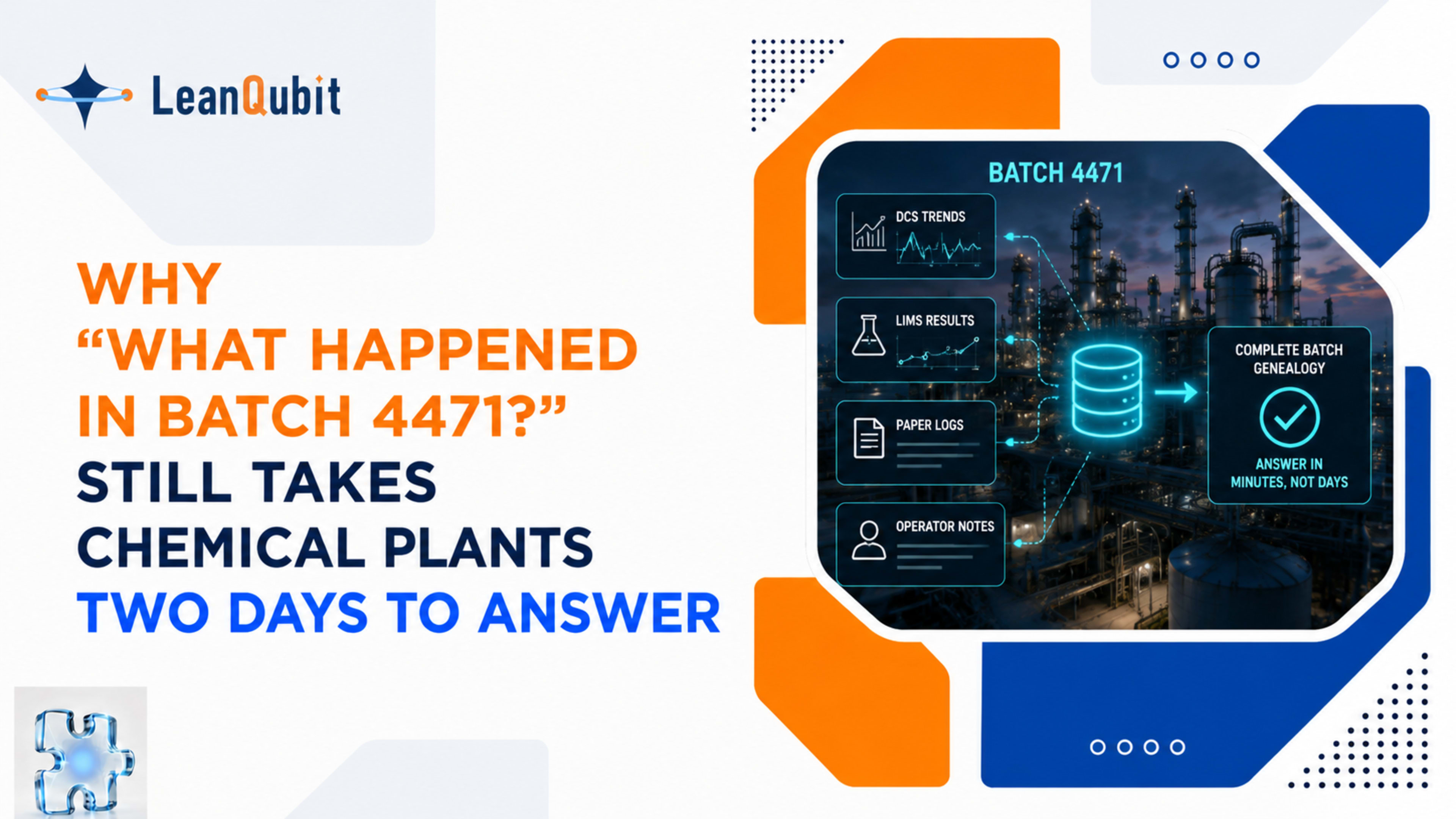
- A batch record proves a batch happened; a batch genealogy explains why it happened the way it did — and most chemical plants only have the first one in a form anyone can query quickly.
- The real cost of slow deviation investigation isn't the hours spent — it's the decisions made without an answer: batches released under schedule pressure, or held for days while a root cause is chased through disconnected systems.
- Genealogy has to be captured automatically at the moment of production, inside the system running the batch, not reconstructed afterward from DCS trends, LIMS results, and paper batch tickets.
- When material genealogy, recipe execution, and process data live in one place, AI process agents can flag developing deviations while the batch is still running, rather than after a customer complaint triggers the investigation.
The batch record isn’t the same as the batch story
Ask a plant manager at almost any chemical facility whether they can produce a batch record for a given lot, and the answer is yes — usually within minutes. Ask them to explain exactly why that batch came in at the edge of specification — which raw material lot fed the reactor, what the temperature and addition-rate profile looked like at a specific point in the run, which operator made an adjustment, and what else was running on adjacent equipment at the time — and the timeline changes completely. In a lot of plants, that second question is a two-day investigation involving several departments and, if the batch is old enough, more than one printed logbook.
This is the gap between a batch record and a batch genealogy. A batch record is a static document — proof that a batch was made, with the ingredients, the theoretical steps, and a sign-off. A genealogy is a linked chain: which raw material lots went into which sub-batches, which equipment and process parameters were active at each processing step, which SOPs and deviations applied, and how all of that maps to the finished lot’s quality results. Most chemical manufacturers have the record. Very few have the genealogy in a form that can be queried in a few minutes.
Why chemical manufacturing makes this harder than discrete manufacturing
In discrete manufacturing, traceability is largely a matter of linking part serial numbers together — a relatively linear chain. Chemical manufacturing is structurally different, and that difference is exactly why genealogy is harder to get right:
- Material identity changes mid-process. A raw material lot doesn’t stay identifiable once it’s charged into a reactor — it becomes part of a new substance, sometimes across multiple reaction and blending steps, sometimes split into sub-lots that get recombined later.
- Process parameters matter as much as material inputs. Two batches made from identical raw material lots can behave differently depending on temperature ramp rate, addition sequence, mixing speed, or hold time — variables that discrete manufacturing rarely has to trace at this resolution.
- Data lives in more places. Reactor and DCS trend data usually sits in one historian, lab results sit in a LIMS, raw material lot data sits in an ERP, and the recipe or SOP that was supposed to be followed sits somewhere else — often on paper or in a document system that isn’t linked to any of the above.
- Regulatory and customer expectations assume the linkage already exists. Whether the driver is a compliance documentation request, a customer complaint, or an internal deviation investigation, the expectation is a complete, connected answer — not several separate exports someone has to reconcile by hand.
The anatomy of a two-day investigation
It’s worth walking through what actually happens when a batch comes in off-spec, because the delay rarely comes from any single step — it comes from the handoffs.
A quality result flags an out-of-spec batch. Someone pulls the batch record to confirm which raw material lots were charged. Someone else exports DCS trend data for the relevant time window and tries to line it up against the batch record’s timestamps — which is harder than it sounds when the historian and the MES don’t share a common batch identifier. A third person checks whether any deviations or manual overrides were logged during that run, often by asking the shift supervisor to recall what happened. If the investigation needs to trace backward — was this raw material lot used in any other batches, and did those batches show the same issue — that’s often a separate manual search through inventory records.
None of these steps is unreasonable on its own. The problem is that they run sequentially, across systems that weren’t built to talk to each other, and each handoff adds waiting time for someone’s attention. By the time the investigation closes, the plant has often already made the decision it was trying to avoid: releasing a marginal batch under schedule pressure because the answer wasn’t ready in time, or holding good batches unnecessarily because there wasn’t a fast way to rule out a contamination path.
When you’re evaluating whether your plant actually has genealogy — not just records — ask this question about a real batch from last month: “Which other batches used the same raw material lot as Batch 4471, and can I see that list in under two minutes?” If the answer requires a manual cross-reference between ERP and MES data, the genealogy doesn’t exist yet — it just looks like it does on paper.
What real-time genealogy actually means on the plant floor
Real-time genealogy isn’t a reporting feature bolted onto an MES after the fact — it’s a property of how production data is captured while the batch is running. That distinction matters, because genealogy reconstructed after the fact from disconnected exports is only ever as complete as the weakest system in the chain.
In practice, this means every raw material lot consumed at a process step is linked to that step automatically as it’s consumed — not keyed in later from a printed pick list. It means process parameters (temperature, pressure, addition rates, mixing speed, hold times) are captured against the batch and the specific process step, rather than stored in a historian with a timestamp someone has to line up manually afterward. It means recipe execution — which version of the recipe ran, which parameters stayed within the approved range, and where an operator deviated and why — is recorded as part of the same data model as material consumption, not in a separate document.
This is the design principle behind FactoMES’s real-time material traceability and genealogy capability: material flow, process execution, and recipe data are captured together as production happens, rather than assembled afterward from separate systems. Recipe management and order execution sit in the same data model, so a batch’s genealogy and the recipe it was supposed to follow are two views of the same underlying record — not two documents someone has to reconcile.
Recipe management and genealogy are the same problem, seen from two ends
It’s worth being explicit about why recipe management belongs in the same conversation as genealogy, because plants often treat them as separate initiatives. A recipe defines what should happen: material quantities, process parameters, sequence, and approved ranges. A genealogy records what actually happened. The value of connecting them isn’t just convenience — it’s that deviations become visible as deviations, automatically, rather than requiring someone to notice that an operator’s manual entry doesn’t match the documented SOP.
When recipe execution and genealogy share a data model, a batch that ran outside its approved temperature range, or that substituted an alternate raw material lot without the expected approval step, shows up as a flagged exception connected to that specific batch — not as a discrepancy someone has to spot by comparing two documents side by side weeks later.
Where AI fits: from investigation to early flag
Genealogy that’s captured in real time creates a second opportunity beyond faster investigations: it becomes usable input for process AI. LeanQubit’s ProcIQ, one of the AI agents built on top of FactoMES and FactoIQ, is designed to optimize process parameters, detect anomalies in operations, and recommend improvement actions — but it can only reason about a batch if the process and material data behind that batch is structured and connected in the first place. QualIQ, the quality AI agent, works the same way on the output side — monitoring quality metrics and analyzing root causes using sensor data, which depends on that same connected data model linking process conditions to results.
This is the practical difference between a plant that has genealogy and one that doesn’t: in the first, a developing deviation — a temperature profile drifting from an established pattern, an addition rate trending outside historical norms — can be flagged while the batch is still running, when there’s still time to intervene. In the second, the same deviation is only visible after the fact, once someone starts the two-day investigation.
FactoLake, LeanQubit’s industrial data lake built on Apache Iceberg, is designed to give OT and IT teams secure, structured access to the same underlying production data — so genealogy analysis, quality trend reporting, and AI model training can all draw from a single source of truth instead of separate exports.
What to look for when evaluating traceability capability
If your plant is evaluating whether its current systems — or a new MES — actually deliver genealogy rather than just batch records, a few questions cut through vendor marketing quickly:
- Can you trace forward and backward from any raw material lot to every batch it touched, without a manual cross-reference between systems?
- Are process parameters linked to the specific batch and process step automatically, or does someone have to line up historian timestamps by hand?
- Does the recipe that was supposed to run and the record of what actually ran live in the same data model, so deviations surface automatically?
- Can quality results, material consumption, and process data all be queried together for a single batch, in one place, without exporting from three systems first?
If the honest answer to more than one of these is “not without manual work,” the plant has batch records, not batch genealogy — and every deviation investigation will keep taking as long as the slowest handoff in the chain.
Conclusion
Chemical manufacturers don’t lack data — most plants are drowning in DCS trends, LIMS results, and ERP records. What they lack is the connection between those systems that turns a two-day investigation into a two-minute query. Real-time batch genealogy isn’t an add-on report; it’s a design decision about how material, process, and recipe data get captured in the first place — and it’s the foundation that makes process AI, quality AI, and faster regulatory response possible on top of it.
Frequently Asked Questions
Not quite. An eBR digitizes the batch record — the ingredients, steps, and sign-offs — but doesn’t necessarily link that record to process parameter data or connect it automatically to every other batch that shares a raw material lot. Genealogy is the connected chain across material, process, and quality data; an eBR is often one piece of that chain, not the whole thing.
Auditors and customer quality teams typically ask for the same connected answer that an internal deviation investigation needs: which materials, which process conditions, which approvals, for a specific batch or a specific raw material lot across every batch it touched. When that answer already exists as a queryable record instead of a manual reconstruction, audit response time drops accordingly — though the exact time saved depends on how fragmented the plant’s current systems are.
No. Real-time genealogy is about how the MES layer captures and links data as production happens — it’s designed to integrate with existing SCADA, DCS, and ERP systems (via IIoT integration and platforms such as Ignition) rather than replace the process control layer underneath them.
A LIMS holds quality results and an ERP holds material and inventory data, but neither is built to link the two together against process execution as it happens. Genealogy sits in the layer between them — the MES — which is why plants with a LIMS and an ERP can still spend days reconciling a single deviation investigation.
If your plant is still reconstructing genealogy from disconnected systems after every deviation, it’s worth a conversation about what real-time traceability inside FactoMES would look like for your process. Book a scoping call with LeanQubit’s engineers to see how batch genealogy, recipe management, and process AI fit together for chemical manufacturing environments.