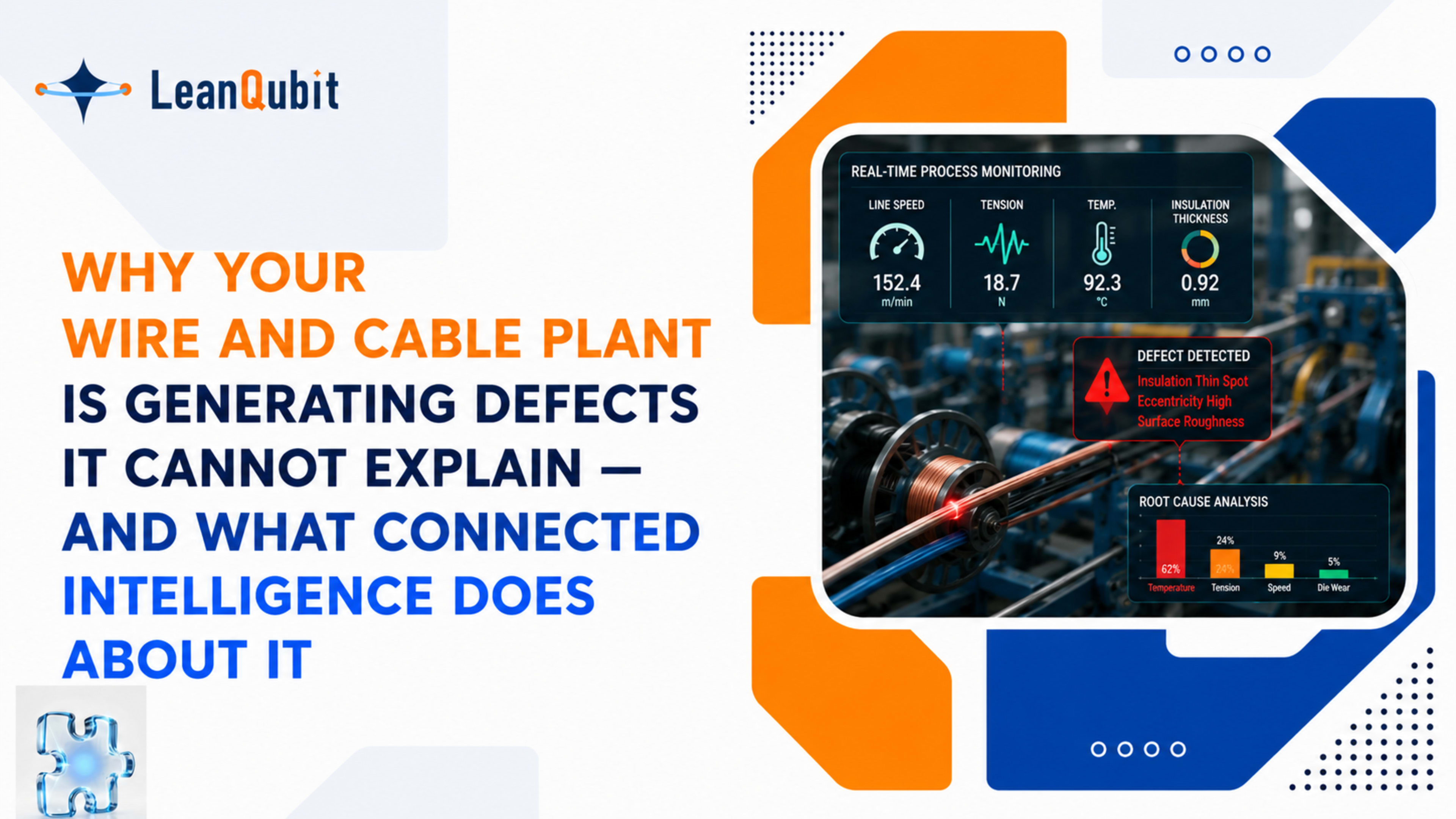
- Defects in wire and cable manufacturing are rarely random — they are process-driven, and most can be traced to deviations in drawing speed, extrusion temperature, or compound consistency that went undetected in real time.
- The multi-stage nature of wire and cable production — drawing, annealing, stranding, extrusion, and final testing — means that a deviation at one stage is often detected only several stages later, multiplying the embedded cost of every reject.
- Real-time IIoT connectivity across drawing machines, extruders, and inline testers enables manufacturers to catch process deviations at the point of origin rather than at the point of rejection.
- End-to-end lot traceability — linking conductor batch, compound batch, and machine parameters to each production reel — is the data foundation that makes root-cause analysis actionable rather than speculative.
- Wire and cable plants that unify process, quality, and machine health data into a single operational platform can shift from reactive defect investigation to proactive process control — and build a compounding operational advantage over time.
Wire and cable manufacturing looks deceptively simple from the outside. Copper or aluminium in one end, insulated cable out the other. In practice, it is one of the more process-sensitive industries in manufacturing — a continuous production environment where dozens of interdependent parameters must stay within tight tolerances simultaneously, across every metre of product on every shift.
When something goes wrong — an insulation void, a conductor diameter deviation, a spark-test failure, a surface defect that shows up only at final inspection — the instinct is to find the problem and fix it. But in a continuous process running at high line speeds, “finding the problem” often means reviewing hours of handwritten shift logs, manually correlating data from disconnected machines, and eventually tracing the defect back to a parameter deviation that happened long before anyone noticed something was off.
This is the central quality challenge in wire and cable manufacturing. It is not a shortage of data — most plants have PLCs, process controllers, and inline measurement systems generating far more data than anyone can review. The problem is that the data is not connected, not real-time, and not structured in a way that enables fast, accurate root-cause investigation. The defect and its cause are separated by time, stage, and data silo — and that gap is where scrap, rework, and customer escapes live.
The Multi-Stage Problem: Why Defects Are Always Found Downstream
Wire and cable production is a sequential, continuous process. A typical production sequence runs through conductor drawing and annealing, stranding or bunching, insulation extrusion, sheathing, and final electrical and dimensional testing — each stage building directly on the quality of what came before it.
This sequential dependency is what makes defect detection so operationally painful. A wire drawing machine running marginally too fast under insufficient lubrication may produce a conductor with subtle surface scoring. That scoring may not trigger an alarm at the drawing stage. It may not even be visible on the strand. But when the insulated core reaches the spark tester at the end of the line, it fails — and by that point, the machine has been running for hours and several reels of product have already been produced with the same underlying issue.
The cost structure of this delayed detection dynamic is significant. Every stage a defect passes through embeds additional material, energy, and machine time into a product that will ultimately be scrapped or require costly rework. For high-value products — medium-voltage power cables, automotive wire harnesses, aerospace-grade conductors — the cost per reject reel is not trivial. And for commodity wire products where margin is thin, even small sustained defect rates erode profitability at scale.
The gap between where a defect is created and where it is detected is where the real quality cost lives in wire and cable manufacturing. Narrowing that gap through real-time process monitoring is the single most effective lever for reducing scrap and customer returns.
The operational consequence is equally damaging. When a quality failure is detected at final test, it triggers a backwards investigation: which reel, which shift, which machine, which parameter. Each of these questions requires data retrieval from a different system — the drawing machine controller, the extrusion line HMI, the compound batch record, the shift log — and manual correlation by engineers who are simultaneously trying to manage current production. It is slow, imprecise, and exhausting. And when it does produce an answer, that answer is rarely timely enough to prevent the next occurrence.
Where the Data Exists — and Why It Does Not Work Together
Walk through a modern wire and cable facility and you will find substantial data infrastructure already in place. Drawing machines log line speed, die temperature, and break frequency. Extrusion lines monitor melt temperature, head pressure, screw speed, and line speed. Inline diameter gauges and capacitance testers generate measurement streams at hundreds of points per minute. SCADA systems capture PLC signals across the line. ERP systems hold compound batch records, material certificates, and production orders.
What you typically will not find is any of these systems communicating with each other in a way that enables cross-stage process analysis. Each system captures what it knows. None of them generates the cross-referenced, time-aligned operational picture that a quality engineer actually needs to trace a defect to its root cause.
The practical consequences of this data silo structure are consistent and predictable across wire and cable plants:
- Spark-test failures trigger manual investigations that take hours to complete and rarely produce confident root-cause conclusions
- Extruder barrel wear, die degradation, and compound temperature drift accumulate gradually and are only identified after quality has already been affected
- Compound batch traceability exists on paper or in ERP, but is not linked in real time to the process parameters active when that compound was running on the line
- Downtime events are captured, but often in generic categories that do not support failure pattern analysis or predictive maintenance
- OEE calculations rely on end-of-shift manual data entry rather than continuous machine signal capture, making them retrospective and often inaccurate
Breaking down these silos — not by replacing existing systems, but by connecting them into a unified operational data layer — is the foundational change that enables every other improvement that follows.
Real-Time Process Monitoring: Catching Deviations Where They Start
The wire drawing machine is where conductor quality is established. Die wear, lubrication temperature, and drawing speed interact to determine the surface quality, dimensional consistency, and mechanical properties of the conductor that every downstream process depends on. Yet in many plants, these parameters are monitored only within the machine’s own controller — and alerts only trigger when deviations are already severe.
Real-time IIoT connectivity changes what is possible here. When drawing machine parameters — line speed, die exit temperature, break frequency, lubricant flow rate — are continuously streamed to a centralised monitoring platform, patterns become visible that would otherwise be buried in data that nobody reviews until something fails. A gradual increase in break frequency over a shift, correlated with a rising die temperature, is a detectable leading indicator of die wear or lubricant degradation. Identified in real time, it triggers a preventive intervention. Missed until a product failure occurs downstream, it triggers a crisis.
The same principle applies at the extrusion stage. Melt temperature variation, screw speed instability, and head pressure fluctuation are the parameters most directly linked to insulation eccentricity, wall thickness variation, and surface finish defects. When these parameters are monitored continuously and compared against the process window validated for each product specification, deviations can be flagged and corrected within minutes — not discovered at the spark tester hours later.
Start IIoT connectivity at the extruder head pressure and melt temperature sensors. These two parameters are the strongest leading indicators of insulation eccentricity and wall thickness variation — the most common causes of spark-test failures. This is typically the highest-ROI entry point for real-time monitoring in a cable plant.
Inline measurement data — diameter gauges, wall thickness testers, and capacitance monitors — generates high-frequency streams that are ideally suited for real-time Statistical Process Control. When this data flows continuously into a monitoring platform rather than being recorded in batches or reviewed only at shift end, process capability can be tracked in real time, and control limits can trigger alerts before out-of-specification product accumulates.
Lot Traceability: The Missing Link Between Process and Product
One of the most underappreciated operational capabilities in wire and cable manufacturing is genuine end-to-end lot traceability — the ability to answer the question: which conductor batch, produced on which drawing machine under which parameters, combined with which compound batch, extruded under which conditions, is on which output reel?
Most plants have some version of this information. Conductor lot codes are recorded. Compound batch numbers appear on production orders. But the linking of these records to the specific process parameters active at the time of production — and the ability to query across these dimensions in minutes rather than hours — is where most facilities fall short.
The operational value of connected traceability is most clearly visible in two scenarios. The first is a customer return or field complaint: when a specific cable lot is implicated in a failure, the ability to immediately retrieve the full process record for that lot — machine parameters, material batch, inline measurement history, operator notes — compresses the investigation from days to hours and produces a far more defensible quality response. The second is a production quality hold: when a spark-test failure is identified, connected traceability allows the quality team to determine immediately which reels are affected and which are clear, rather than placing a broad hold on all product produced since the last confirmed good test.
This capability also directly supports the regulatory and customer audit requirements that are increasingly common across the cable industry — UL, CSA, IEC, and automotive industry customer-specific quality standards all expect manufacturers to demonstrate material traceability and process control, and connected digital systems are far more credible evidence than spreadsheet logs assembled after the fact.
Machine Health and Predictive Maintenance in a Continuous Process
Wire and cable production runs continuously — often 24 hours a day across multiple shifts. This creates a maintenance challenge that is distinct from batch or discrete manufacturing: an unplanned breakdown does not just stop a production order. It stops a continuous production line, creates a recovery sequence with significant scrap implications, and potentially affects in-process product that cannot be paused midway through the process.
The equipment categories most exposed to this risk are predictable. Drawing machine capstans and wire guides accumulate wear gradually. Extruder screws and barrels degrade over time, showing up first as process drift before producing dimensional failures. Cooling troughs and caterpillar haul-off units develop mechanical inconsistencies that translate directly into line speed variation and product quality issues. None of these failure modes announce themselves suddenly — they develop gradually, and their early indicators are detectable in machine data long before a breakdown occurs.
Predictive maintenance in this environment depends on connecting machine sensor data — vibration, temperature, current draw, cycle time — to a monitoring platform that can identify the gradual trend signatures that precede failure. When a capstan motor’s current draw begins increasing outside its normal operating range, or a cooling trough pump shows vibration patterns inconsistent with its baseline, a predictive alert enables a planned intervention during a scheduled maintenance window rather than an unplanned breakdown mid-shift.
For wire and cable plants, the operational value of this shift is amplified by the continuous-process context. Every unplanned breakdown carries a recovery cost — purging and restarting an extruder, re-threading the line, inspecting and scrapping the in-process product at the moment of failure — that is disproportionately high relative to the cost of a planned maintenance intervention. Catching the failure signal early transforms a crisis into a scheduled event.
Production Scheduling and Changeover Management in a High-Mix Plant
Wire and cable plants increasingly operate in high-mix environments — many SKUs, varying product specifications, frequent changeovers between different conductor sizes, insulation compounds, and product types. In this context, production scheduling is not just a planning function. It directly drives the quality, efficiency, and changeover losses that determine plant profitability.
A poorly sequenced schedule creates unnecessary compound changeovers, requires die changes between incompatible product sizes, and leaves extruder lines running at suboptimal speeds for extended periods. An intelligently sequenced schedule minimises transition losses, groups compatible products into production families, and optimises the utilisation of both machine assets and operator time. The difference between these two scenarios, across a full production period, is measurable in both scrap rate and throughput.
Scheduling intelligence in this environment requires inputs that most wire and cable plants do not currently surface in a structured way: actual changeover times by product pair and machine combination, real throughput rates by product and shift, machine availability considering maintenance requirements, and compound shelf life and lot priority constraints. When these inputs are captured systematically — through a connected MES rather than relying on planner experience alone — scheduling optimisation becomes a data-driven capability rather than an art.
In high-mix wire and cable plants, changeover losses — the scrap generated during transitions between products — often represent 5–15% of total production volume. Intelligent scheduling that minimises unnecessary changeovers and sequences compatible products together is one of the highest-leverage efficiency improvements available without additional capital investment.
What a Connected Intelligence Platform Looks Like in a Cable Plant
The capabilities described above — real-time process monitoring, connected traceability, predictive maintenance, and intelligent scheduling — are not independent projects. They are facets of a single underlying requirement: a unified operational data platform that connects the machines, processes, systems, and data flows of the plant into one coherent intelligence layer.
In a wire and cable manufacturing context, this platform needs to address several practical requirements:
- High-frequency data ingestion from legacy PLC-controlled drawing machines and extrusion lines using standard industrial communication protocols (OPC-UA, Modbus, and similar), without requiring equipment replacement
- Real-time inline measurement data ingestion from diameter gauges, wall thickness monitors, spark testers, and capacitance testers — the quality instruments that are already installed but whose data is rarely integrated
- Product-level traceability linking conductor batch, compound batch, and process parameters to each output reel as a continuous, digital production record
- Scalable storage architecture capable of handling the high-frequency, high-volume data streams that continuous production generates — across multiple lines and shifts
- Analytics that surface cross-stage correlations — connecting spark-test failure rates to upstream extruder parameters or conductor surface quality to drawing machine conditions — without requiring manual data assembly
- Secure OT-IT access architecture that makes data available to quality engineers, process engineers, plant managers, and production planners without exposing PLC systems to unnecessary connectivity risk
This is the architecture that industrial data lake platforms and Manufacturing Execution Systems are designed to support. The IIoT integration layer — connecting machines to the data platform — is the enabling foundation. The analytics, traceability, and scheduling capabilities are the operational value that the integration makes possible.
For wire and cable manufacturers considering where to start, the practical entry point is typically IIoT connectivity on the most critical process equipment — the extrusion line and the drawing machine — combined with a unified production record that links process parameters to output reels. This immediately creates the cross-stage visibility that most plants currently lack, and it provides the data foundation that every subsequent capability depends on.
Conclusion
Wire and cable manufacturing is a precision process running at high speed, across multiple shifts, on products that carry real safety and performance obligations. The operational problems that drive quality cost, scrap, and customer escapes in this industry are not mysteries — they are process deviations that generate detectable signals before they produce failures. The gap is not the absence of data. It is the absence of connected data: process records that speak to each other, quality outcomes linked to upstream machine parameters, and traceability that can be queried in minutes rather than assembled over hours.
Closing that gap requires a connected intelligence platform — one that brings IIoT data from drawing machines and extruders, inline measurement and test results, material batch records, and production execution data into a unified operational layer. When that foundation is in place, the shift from reactive investigation to proactive process control becomes an operational reality rather than an aspiration. Root-cause analysis compresses from days to hours. Process deviations are caught at the drawing stage rather than the spark tester. Maintenance interventions are planned rather than unplanned. And every production run contributes to a growing dataset that improves process knowledge and AI model accuracy over time.
For wire and cable manufacturers competing on product consistency, delivery reliability, and margin efficiency, this is not a future capability — it is a present-day operational imperative. The manufacturers building this foundation now are developing a structural advantage that compounds. The ones relying on manual data assembly and disconnected systems are funding it.
Frequently Asked Questions
Spark-test failures are most commonly linked to insulation voids, wall thickness underruns, or surface contamination introduced at the extrusion stage. The primary process drivers are melt temperature variation, head pressure instability, die wear, and compound contamination from a previous batch or from moisture in the feedstock. Identifying which of these is responsible requires correlating the spark-test result with the extrusion process record from the affected production window — which is only practical when those records are connected and searchable in real time.
Modern IIoT integration approaches allow sensors and data collection gateways to be deployed on existing equipment using standard industrial communication protocols. Most PLCs in wire and cable plants already expose process data via OPC-UA, Modbus, or proprietary protocols that can be bridged. The integration does not require equipment replacement — it requires a connectivity layer that reads existing signals and routes them into a centralised data platform. This is one of the key practical advantages of an OT-IT integration approach designed for industrial environments with significant legacy equipment.
Genuine end-to-end traceability requires the ability to link, for every output reel, at minimum: the conductor lot and drawing machine parameters active when that conductor was produced, the compound batch and its material certification, the extrusion line process parameters active during production, and the inline measurement and test results for that reel. This information typically already exists across multiple systems — ERP, machine controllers, test equipment logs — but is not connected. The traceability capability is created by connecting these records through a unified production data layer that assigns a common identifier to each production unit as it moves through the process.
Yes. Both machine categories have detectable leading indicators of degradation and failure that appear in machine data — vibration patterns, current draw trends, temperature drift, and process parameter variability. Drawing machine capstan and guide wear, extruder screw and barrel degradation, and cooling system inconsistencies all produce signature patterns in continuous machine data that can be identified through time-series analysis before they reach the point of breakdown or product quality impact. The prerequisite is continuous data collection from the relevant machine signals, which IIoT connectivity enables.
Scheduling in a high-mix wire and cable plant involves managing product sequencing to minimise changeover losses, compound waste, and unnecessary die changes. Connected process data contributes to this in two ways: by providing actual throughput rates and changeover time histories that make schedules realistic rather than theoretical, and by surfacing machine availability constraints — maintenance windows, degradation alerts — that affect which equipment can run which products at a given time. A scheduling tool that incorporates these real inputs generates sequences that are both optimal and executable, rather than plans that require constant manual adjustment on the floor.
The most practical entry point is IIoT connectivity on the extrusion line — specifically melt temperature, head pressure, and inline diameter measurement — combined with a production record that links these parameters to each output reel. This immediately creates the ability to correlate spark-test results with upstream extrusion conditions, which is the most common root-cause investigation in most cable plants. Drawing machine connectivity is a natural second step, as it enables conductor surface quality tracking that completes the upstream process picture. The data infrastructure established at this stage supports every subsequent capability — predictive maintenance, traceability, and scheduling optimisation.
Ready to explore what connected process intelligence could look like in your wire and cable plant? Talk to the LeanQubit team about how FactoMES, FactoIQ, FactoLake, and IIoT integration can help you build an end-to-end process monitoring and quality traceability solution tailored to your production environment.